FAMSI Resources


Logo
570 records searched.


Results 6 - 20 of 570
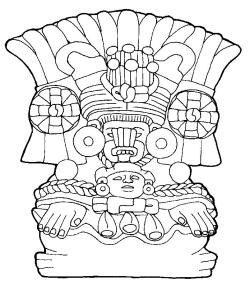
Key:  MNA 6-7891
Actual Location:  National Anthropology Museum, Mexico City, Mexico (exhibited).
Registration:  6-7891 / INAH 10-228149
Provenance:  Unknown
Measurements:  60 x 35 x 40 cm.
Color:  Brown clay with traces of red paint in the face and hands.
Chronology:  Peche 500 - 600 AD
  Click to view Chronology
Reference:  Exhibition at San Ildefonso, Mexico City: Fragments of the Past, 1999; Oaxaca: Magie van Mexico 1993: fig. 12.
Comments:  There is another piece, identical to this one, in a private collection in California. See KAISER 1.
Glyphs:  Glyph C in the headdress.

Click to view high resolution in a new window
select this image for review

Key:  KAISER 1
Actual Location:  Berkeley, California, United States.
Collection:  Dr. William F. Kaiser
Provenance:  Unknown
Measurements:  66 cm.
Color:  Brown clay.
Chronology:  Peche 500 - 600 AD
  Click to view Chronology
Reference:  Pre-Columbian Art of Mexico and Central America,1968: fig. 238.
Comments:  This piece is identical to piece MNA 6-7891 and is probably its counterpart. Some details are missing, such as part of the ear piece, a canine tooth in the mouth and the elements coming out of the pot. This piece's headdress is more complete.
Glyphs:  Glyph C in the headdress.

Click to view high resolution in a new window
select this image for review

Key:  MNA 6-30
Actual Location:  National Anthropology Museum, Mexico City, Mexico (exhibited).
Registration:  30-6
Provenance:  Tomb 51, no. 40, Monte Albán, Oaxaca.
Measurements:  31 cm.
Color:  Grey clay
Chronology:  MA IIIB (Caso and Bernal 1952: 252); Peche 500 - 600 AD
  Click to view Chronology
Reference:  Caso and Bernal 1952: 252, fig. 397; Exhibition Fragments of the Past, San Ildefonso, Mexico City, 1999.
Comments:  Tomb 51 was excavated by Caso in the field season PMA III (1933-1934) and was dated MA IIIB-IV.
Glyphs:  Glyph P indicated by the vertical lines crossing the face.

Click to view high resolution in a new window
select this image for review

Key:  MNA 6-6067
Actual Location:  National Anthropology Museum, Mexico City, Mexico (exhibited).
Collection:  Guillermo Dupaix; Fausto de Elhúyar?; Sánchez and Mora (former Count of Peñasco).
Registration:  138 (old number of Sánchez & Mora?) / 6-6067 / INAH 10-3292
Provenance:  Zaachila, Oaxaca.
Measurements:  55 x 32 cm.
Color:  Sandy stone, almost white. Traces of red pigment.
Chronology:  Pitao 350 - 500 AD
  Click to view Chronology
Reference:  Dupaix [1805-7]1978: plate 72; Drawing by Franck 1827: plate 14; Mayer 1844: 279; Easby & Scott 1970: fig. 158; Solis 1991: 161, fig. 237; López Austin 1995: 133, fig. 138.
Comments:  This piece is made of stone. Guillermo Dupaix found the object in the cemetery, near the curacy of Zaachila, but few have reported this information. The card of the National Anthropology Museum, where the piece is exhibited, says that it comes from Tututepec, Oaxaca. Several authors and catalogs maintain that it comes from Monte Albán (cf. López Austin 1995: 133; Solis 1991: 161, fig. 237).
Glyphs:  Glyph C in the headdress flanked by two ears of corn.

Click to view high resolution in a new window
select this image for review

Key:  MNA 6-2289
Actual Location:  National Anthropology Museum, Mexico City, Mexico.
Registration:  6-2289; 6-2290; 6-2291; 6-2292; 6-2293; 6-2294
Provenance:  Tomb 40, No. 3, Monte Albán, Oaxaca.
Measurements:  32 cm.
Color:  Grey clay
Chronology:  Xoo 600 - 800 AD
  Click to view Chronology
Reference:  Caso and Bernal 1952: 92, fig. 152, a & b; Eubanks 1999: 106-108, fig. 84.
Comments:  Five pieces like this one were found, all identical and as part of a series. Tomb 40 was excavated by Caso in the period PMA III (1933-1934) and in the date MA IIIB-IV.
Glyphs:  Glyph C in the headdress flanked by two ears of corn.

Click to view high resolution in a new window
select this image for review

Key:  MNA 6-6592
Actual Location:  National Anthropology Museum, Mexico City, Mexico (warehouse).
Registration:  "piece 4 / 6-6592"
Provenance:  Unknown
Measurements:  52 cm.
Chronology:  Tani 200 - 350 AD
  Click to view Chronology
Reference:  Caso and Bernal 1952: 34, fig. 34.
Comments:  Caso and Bernal maintain that there is a glyph in the headdress with three numerals, but they cannot be seen in the drawing presented by them. I have had the opportunity of seeing this piece in the warehouse of the National Anthropology Museum and can confirm the coefficients engraved in the middle of the glyph.
Glyphs:  Glyph 3 L in the headdress under a glyph C.

Click to view high resolution in a new window
select this image for review

Key:  MNA 9-4878
Actual Location:  National Anthropology Museum, Mexico City, Mexico (exhibited).
Registration:  9-78
Provenance:  Teotihuacan, South-East room of the Oaxacan zone (site 7 in grid N1W6).
Measurements:  34 cm.
Color:  Red paint, more intense in glyph and face. Decorated with green stone and shell.
Chronology:  Pitao 350 - 500 AD
  Click to view Chronology
Reference:  Millon 1967: 42-44.
Comments:  Millon maintains that this vessel was linked to a ritual involving a hearth that was inside the room where the piece was found. Parts of the vessel were disseminated to the North and East of the room, but the piece's face was deliberately placed near the North wall, facing upwards and protected by a stone slab. Immediately after or during the ritual, the walls were torn down and loads of crushed tepetate, broken floor pieces and remains of walls ("bajareque") as well as other types of filling were thrown into the room (Millon 1967: 43).
Glyphs:  Glyph 8 J (corn) in the headdress.

Click to view high resolution in a new window
select this image for review

Key:  MNA 6-78
Actual Location:  National Anthropology Museum, Mexico City, Mexico (exhibited).
Registration:  6-78; INAH 10-3199
Provenance:  Cistern IV, Monte Albán, Oaxaca.
Measurements:  14.4 x 12 cm.
Color:  Orange and grey.
Chronology:  MA IIIA (Caso and Bernal 1952: 297); Pitao 350 - 500 AD
  Click to view Chronology
Reference:  Caso and Bernal 1952: 174, fig. 297; Paddock 1966: 132, fig. 106; Funerary furniture (Mobilier funéraire) fig. 5; The richness of Ancient Mexico (Les richesses de l'Ancien Mexique), 1994: 6, fig. 4.
Comments:  Caso and Bernal (1952: 174) designate this piece as MA-IIIA because the rim of the vase is wide and turned outwards like in the "flower vases" that were characteristic of the time. Because the efigie is wearing a "huipil" it probably represents a female impersonator.
Glyphs:  Human figure with an owl's head or glyph F and, in the chest, numeral 1 (1 F).

Click to view high resolution in a new window
select this image for review

Key:  MNA 6-388
Actual Location:  National Anthropology Museum, Mexico City, Mexico (exhibited).
Collection:  Francisco Belmar #62; according to Martínez Gracida (1910: 107), it was found in 1896.
Registration:  6-388 or 6-6047
Provenance:  Atzompa, Oaxaca.
Measurements:  71 x 14 cm.
Color:  Grey clay with traces of white and red paint.
Chronology:  Peche 500 - 600 AD
  Click to view Chronology
Reference:  No. 62 in Belmar's catalog (AH/ MNA, vol. 11, fs. 17-35); Martínez Gracida 1910: 107; Caso & Bernal 1952: 285, fig. 431, Marcus 1983: fig. 5.11; Solis 1991: 158, fig. 230; Marcus and Flannery 1996: 210, fig. 247.
Comments:  According to Belmar, the figure represents a man. Martínez Gracida says it represents a "priestess". Caso and Bernal use this vessel to define the category "Goddess 13 Serpent". Caso and Bernal (1952) and also Marcus (1983) published the artifact without origin. Later, Marcus and Flannery (1996: 210, fig. 247) maintained that the provenance was Monte Albán. According to Belmar's Collection list, it comes from Atzompa and was excavated by the collector himself.
Glyphs:  Glyph 13 V on the chest.
Dating:  TL by Peter Schaft 1999: authentic (Martha Carmona, personal communication 1999).

Click to view high resolution in a new window
select this image for review

Key:  MNA Mont. YW ofrenda 1-2
Actual Location:  National Anthropology Museum, Mexico City, Mexico.
Provenance:  Mound YW, West of "Y" site, offering I, number 2, Monte Albán, Oaxaca.
Measurements:  15 x 7.5 cm.
Chronology:  Peche 500 - 600 AD
  Click to view Chronology
Reference:  Caso and Bernal 1952: 289, fig. 439; Caso et al. 1967: 122, fig. 78, no. 2 (drawing)
Comments:  Drawing based on Mendoza. This piece was found under stelae no. 16. There was a small pot under the urn, made of grey, polished and thin clay (cf. Caso et al. 1967: 122, Fig. 78, no. 3).
Glyphs:  Glyph E "Xoo" in the pectoral. Underneath, there is another shape that is not well understood yet, but it could be an alligator's eye.

Click to view high resolution in a new window
select this image for review

Key:  MNA 6-4852
Actual Location:  National Anthropology Museum, Mexico City, Mexico.
Registration:  6-52
Provenance:  Antechamber of tomb 103, no. 1, Monte Albán, Oaxaca.
Measurements:  37 cm.
Color:  According to Caso's description, huipil: yellow with red tassel; face: red; hair
Chronology:  MA IIIB (Caso and Bernal 1952: 252); Peche 500 - 600 AD
  Click to view Chronology
Reference:  Caso 1938: 69, 70, 71, fig. 88; Caso & Bernal 1952: 288, fig. 437; Romero 1958: 210, plate XLV; Gendrop 1970: 138, fig. 159b.
Comments:  The piece was found in the antechamber of tomb 103, which was excavated by Caso during the sixth period (1937). Next to this piece, a pot with double pouring handle, decorated with a Cocijo head in front and with a black, polished cylindrical glass was found, as well as some fragments of earthenware bowls with fresco polychrome decorations. The tomb was dated MA IIIA-IIIB. See the other two effigy vessels of this tomb under MNA t/103 Nos. 2 and 3.

Click to view high resolution in a new window
select this image for review

Key:  MNA 6-251
Actual Location:  National Anthropology Museum, Mexico City, Mexico.
Registration:  6-251
Provenance:  Tejalapa, Oaxaca.
Measurements:  13 cm.
Chronology:  Peche 500 - 600 AD
  Click to view Chronology
Reference:  Caso and Bernal 1952: 238, fig. 383.
Comments:  The piece has two vases attached to the back. Also see: MNA 6-252, SLAM 1060:1983, MCO t/1991-4
Glyphs:  Glyph E "Xoo" in the pectoral.

Click to view high resolution in a new window
select this image for review

Key:  MNA 6-252
Actual Location:  National Anthropology Museum, Mexico City, Mexico.
Collection:  Fernando Sologuren #548
Registration:  6-252
Provenance:  Huitzo, Oaxaca.
Measurements:  12 cm.
Chronology:  Peche 500 - 600 AD
  Click to view Chronology
Reference:  Caso and Bernal 1952: 238, fig. 382.
Comments:  This piece has two vases attached to the back. Also see: MNA 6-251, SLAM 1060:1983, MCO t/1991-4.
Glyphs:  Glyph E "Xoo" in the pectoral.

Click to view high resolution in a new window
select this image for review

Key:  MNA 6-4846
Actual Location:  National Anthropology Museum, Mexico City, Mexico.
Registration:  6-46
Provenance:  Tomb 109, Monte Albán, Oaxaca.
Measurements:  25 cm.
Color:  Grey clay with red pigment.
Chronology:  Tani 200 - 350 AD
  Click to view Chronology
Reference:  Caso 1938: 92-95, fig. 105; Caso & Bernal 1952: 122, 286, figs. 193, 434; Easby et al. 1970: 145; Bernal 1979: 145.
Comments:  Cocijo's representation in the headdress. The eyes on the woman's face are decorated with shell. Found in tomb 109, in 1937, during Alfonso Caso's sixth field season. The tomb was dated MA II-IIIA (transition).
Glyphs:  Glyph M "Cocijo" in the headdress.

Click to view high resolution in a new window
select this image for review

Key:  MNA 6-6088
Actual Location:  National Anthropology Museum, Mexico City, Mexico (exhibited).
Registration:  6-88
Provenance:  Inside tomb 104, Monte Albán, Oaxaca.
Measurements:  42 cm.
Color:  Grey clay with traces of red paint.
Chronology:  Peche 500 - 600 AD
  Click to view Chronology
Reference:  Caso 1938: 76-85, figs. 101, 102; Caso & Bernal 1952: 101, 104, figs. 168, 168bis, 184 bis; Romero 1958: 183, plate XXXVI; Redmond 1983: 171, fig. 59 ; Winter 1990: 127-128, fig. 54; Flannery & Marcus 1996: 210, 212-214, fig. 246.
Comments:  This piece was found behind the carved gravestone that sealed the tomb. It was placed at the feet of the dead looking South. On both sides of the piece, there were four vessels, smaller and plain. In his work of 1938, Caso called this vessel Pitao Cozobi (God of Corn). Tomb 104 was excavated by Caso in 1937 and dated IIIA-IIIB. In my opinion, it represents a high-ranking figure, acting as a priest. As a note of interest, this piece was removed from the tomb by the then President of the Mexican Republic, Lázaro Cárdenas.
Glyphs:  The mask and tied hair correspond to glyph Ñ. Two glyphs 109 in the headdress.

Click to view high resolution in a new window
select this image for review

Go to Page:  1 2 3 4 5 6 7 8 9 10 11 12 13 14 15 16 17 18 19 20 21 22 23 24 25 26 27 28 29 30 31 32 33 34 35 36 37 38