FAMSI Resources


Logo
570 records searched.


Results 11 - 25 of 73 for "cocijo"
Key:  MA t/104
Actual Location:  Monte Albán, built in the facade of tomb 104.
Provenance:  Monte Albán, Oaxaca.
Measurements:  91 cm.
Color:  Grey clay
Chronology:  Peche 500 - 600 AD
  Click to view Chronology
Reference:  Caso 1938: 73 and 76, fig. 92; Caso and Bernal 1952: 51, fig. 72.
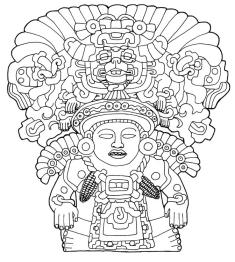
Comments:  The figure holds a bag of incense in one hand and the other hand is stretched out. This hand was mutilated by a tourist a few years back. In 1938, Caso identified this piece as Pitao Cozobi or God of Corn, but later, together with Bernal, they decide to classify it, in their work of 1952, as the "God with Cocijo Head in Headdress". The headdress mask belongs to the Xicani and is flanked by two jaguar heads.

Click to view high resolution in a new window
select this image for review

Key:  MRT 3
Actual Location:  Mexican Museum of Prehispanic Art, Rufino Tamayo, Oaxaca, Mexico.
Collection:  Rufino Tamayo
Provenance:  Unknown
Chronology:  Peche 500 - 600 AD
  Click to view Chronology
Comments:  This large urn of Cocijo is part of a series. There are at least two more of the series, but there were probably up to five pieces in total. One piece is held at the Birmingham Museum in England (BIRM 1965.331) and another is in Stanford, United States (SUAM 1997.167). The said pieces are more complete than the piece illustrated here.
Glyphs:  Glyph C in the headdress.

Click to view high resolution in a new window
select this image for review

Key:  MES 23.8.307
Actual Location:  Swedish Ethnographic Museum, Stockholm, Sweden.
Collection:  August Edwin Paulson
Registration:  23.8.307
Provenance:  Tuxtepec, Oaxaca.
Measurements:  37.9 x 31.9 cm.
Color:  Front part in red. Traces of green paint.
Chronology:  Peche 500 - 600 AD
  Click to view Chronology
Reference:  Linné 1938: 160, plate 31.
Comments:  The piece has been partially restored. According to Linné, it was wearing a Cocijo mask.
Glyphs:  Glyph J in the headdress. Two alligator eyes in the throne's back and above these, two glyphs for sprouted corn.

Click to view high resolution in a new window
select this image for review

Key:  MCT 2
Actual Location:  Civic Museum of Turin, Italy.
Collection:  Zaverio Calpini , circa 1876; Callegari gives an earlier date 1864 (1931: 514).
Provenance:  Nochistlán o Xoxocotlán (Callegari 1931: 514).
Measurements:  23.5 cm.
Chronology:  Pitao 350 - 500 AD
  Click to view Chronology
Reference:  Africa, America, Australasia: the Ethnological Collections, Civic Museum of Turin, 1978: 66, fig. 17.
Glyphs:  In the headdress, glyph M "Cocijo", seen sideways. Beside the jaw, numeral 1 (1 M).

Click to view high resolution in a new window
select this image for review

Key:  GLS 1
Actual Location:  Unknown
Collection:  Guy Loudmer Auction, France.
Provenance:  Unknown
Measurements:  14 cm.
Color:  Grey clay
Chronology:  Pitao 350 - 500 AD
  Click to view Chronology
Reference:  Guy Loudmer auction's catalog, Precolombian Art, fig. 32, Monday, December 9, 1991.
Comments:  Central vessel of a series of three (See GLS 2 for accompanying pieces).
Glyphs:  Under the mask of Cocijo, two numerals, which could be 2 M? but also 2 knot because of the bow on the chest. Glyph C in the headdress.

Click to view high resolution in a new window
select this image for review

Key:  ROM 1435
Actual Location:  Royal Ontario Museum, Toronto, Canada.
Collection:  Constantino Rickards
Registration:  HM 1435
Provenance:  Cuilapan, Oaxaca.
Measurements:  42 cm.
Color:  Grey clay with a lighter layer of stucco.
Chronology:  Xoo 600 - 800 AD
  Click to view Chronology
Reference:  Rickards 1922; Boos 1964b: plate XIa & XIb; Urcid 1998: fig. 3; Sellen 2000b, 2002b.
Comments:  This engraved cylinder has an identical companion (cf. Rickards 1922 and photos of the collection before it reached Canada). The location of the other piece is unknown. The use of this piece is also unknown (cf. Urcid 1998 and Sellen 2002b). The figure of Cocijo has been reproduced twice in the cylinder, carrying objects in both hands, probably corn plants in different stages of development.
Glyphs:  Glyph C in the headdress.
Dating:  TL by Lazos, Ortiz, Ruvalcaba and Sellen, 1999, test #110385: authentic.

Click to view high resolution in a new window
select this image for review

Key:  ROM 1907
Actual Location:  Royal Ontario Museum, Toronto, Canada.
Collection:  Constantino Rickards
Registration:  HM 1907 / 917.4.82
Provenance:  Teojumulco, District of Juquila, Oaxaca.
Measurements:  46 cm.
Color:  Beige clay.
Chronology:  Xoo 600 - 800 AD
  Click to view Chronology
Comments:  This piece is quite unusual. It shows a standing human figure, with a Cocijo mask.
Glyphs:  A glyph C in the headdress.
Dating:  TL by Shaplin and Zimmerman, test #26: authentic.

Click to view high resolution in a new window
select this image for review

Key:  ROM 1945
Actual Location:  Royal Ontario Museum, Toronto, Canada.
Collection:  Constantino Rickards
Registration:  HM 1945
Provenance:  Unknown
Measurements:  20 cm.
Color:  Grey clay. Traces of red pigment.
Chronology:  Niza 100 BC - 200 AD
  Click to view Chronology
Comments:  A very early example of the Cocijo.
Glyphs:  The figure has a variant of glyph C in the headdress. Glyph epsilon or "blood" hanging from the ears.

Click to view high resolution in a new window
select this image for review

Key:  BELMAR 1
Actual Location:  Unknown, probably National Museum of Anthropology in Mexico.
Collection:  Francisco Belmar (#37?)
Provenance:  Unknown
Chronology:  MA IIIB (Boos 1966b: 79); Xoo 600 - 800 AD.
  Click to view Chronology
Reference:  Boos 1966: 79, fig. 58.
Glyphs:  The glyph M (Cocijo) in the headdress is displayed on both sides of the same mask with a front view. Possibly two bars of five attached to the Cocijo's nose: 10?M. A glyph C in the headdress.

Click to view high resolution in a new window
select this image for review

Key:  FASF 128608
Actual Location:  Museo de Artes Plásticas de San Francisco, San Francisco, United States.
Collection:  Doctor Ernest Forbes
Registration:  128608 / Acc. no. DY54376
Provenance:  Unknown
Measurements:  20 x 19 cm.
Color:  Reddish ceramic paste with beige coating.
Chronology:  MA IIIA (Boos 1966b: 235); Pitao 350 - 500 AD
  Click to view Chronology
Reference:  Boos 1966b: 235, fig. 214.
Glyphs:  It wears the mask of glyph M, Cocijo, in the headdress. This piece corresponds to glyph X.

Click to view high resolution in a new window
select this image for review

Key:  MNA 6-635
Actual Location:  National Anthropology Museum, Mexico City, Mexico.
Registration:  6-635
Provenance:  Santa María Atzompa, Oaxaca.
Measurements:  39 cm.
Chronology:  Pitao 350 - 500 AD
  Click to view Chronology
Reference:  Caso and Bernal 1952: 52, fig. 72 bis.; Bernal 1966: 83, fig. 3.
Comments:  Caso and Bernal define this type as "God with Cocijo Head in Headdress". For other examples, see EMB 24882, cm.A 44.78, MFVV 55.158, MDO 32 and MFR s/n 1. For an analysis of this type, see Sellen 2002: 9.
Glyphs:  A glyph C in the headdress.

Click to view high resolution in a new window
select this image for review

Key:  MFR 1822
Actual Location:  Frissell Museum, Mitla, Mexico.
Collection:  Ervin Frissell
Registration:  MFR CC-1822 /INAH 2778
Provenance:  Unknown
Measurements:  21 x 15.5 cm.
Color:  Light grey clay
Chronology:  Xoo 600 - 800 AD
  Click to view Chronology
Reference:  Paddock 1968: 19, fig. 27.
Comments:  Pot with double pouring handles and Cocijo face.
Glyphs:  Glyph C in the headdress. The hairpin glyph decorates the vessel.

Click to view high resolution in a new window
select this image for review

Key:  MNA 6-1203
Actual Location:  National Anthropology Museum, Mexico City, Mexico.
Registration:  6-1203
Provenance:  Ejutla, Oaxaca.
Measurements:  20 cm.
Chronology:  Xoo 600 - 800 AD
  Click to view Chronology
Reference:  Caso and Bernal 1952: 25, fig. 18.
Comments:  Globular pot with double pouring handles and stamped Cocijo face.
Glyphs:  Glyph C in the headdress. The hairpin glyph decorates the pot and the pouring handles.

Click to view high resolution in a new window
select this image for review

Key:  MNA 6-37
Actual Location:  National Anthropology Museum, Mexico City, Mexico.
Registration:  6-37
Provenance:  Entrance 1, no. 8, found in cove 42, under building 43 of the K-System Courtyard, Mitla, Oaxaca.
Measurements:  18 cm.
Color:  Grey clay with a red pigment coating.
Chronology:  MA IIIA (Caso and Bernal 1952: 101); Tani 200 - 350 AD
  Click to view Chronology
Reference:  Caso 1936: 13-14, numberless photo; Caso and Bernal 1952: 101, fig. 167.
Comments:  Caso and Bernal use this piece to define category "Bow God in Headdress". According to Caso, the urn was attached to the pectoral or loincloth, but fell off (Caso 1936: 13). The piece was found with two more (Nos. 6 and 9): one with a serpent's mouth mask and the other, with a headdress featuring the Cocijo and glyph C. The rest of the offering was also very rich in ceramics. There were two skeletons in the burial.

Click to view high resolution in a new window
select this image for review

Key:  MCO 2702
Actual Location:  Museum of Cultures of Oaxaca, City of Oaxaca, Mexico (exhibited).
Registration:  2702
Provenance:  In front of the entrance to tomb 7, Monte Albán, Oaxaca.
Chronology:  Xoo 600 - 800 AD
  Click to view Chronology
Reference:  Caso 1932a: 19-20, fig. 32; Caso 1932b: 466-467; Caso & Bernal 1952: 44, figs. a, b, c; Bernal 1979: 144, fig. 52.
Comments:  This piece was found flanked by two pieces of lid and box, but the lids of the other two pieces are different, as they represent the Cocijo. Caso and Bernal identified the human figure of the illustrated urn as "The God of Corn" (1952: 46). The three pieces were found broken and, according to Caso (1932: 20), the position of the two fragments proves that the break was intentional and that, after doing so, the objects were buried. Caso excavated tomb 7 in the first PMA I period (1931-1932).
Glyphs:  Glyph C in the headdress flanked by two ears of corn.

Click to view high resolution in a new window
select this image for review

Go to Page:  1 2 3 4 5