FAMSI Research Materials


572 records searched.


Click on any image to view in high resolution.
Click the checkboxes and the 'review selections' button to view images with captions in a printable format.
Results 1 - 10 of 179 for "xoo"
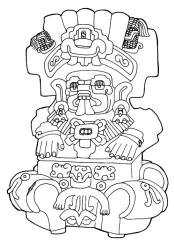
Key:  AMNH 30.0/3
Actual Location:  American Museum of Natural History, New York, United States.
Collection:  Mrs. Robert W. De Forest. Donated in April 1904.
Registration:  30.0/3
Provenance:  Found in a mound in the Valley of Oaxaca.
Measurements:  37.5 x 25 cm.
Color:  
Chronology:  Xoo 600 - 800 AD  Click to view Chronology
Reference:  Saville 1904: 51, photo on p. 50; Eubanks 1999: 125-126, fig. 100.
Comments:  Saville reported that it was found with 5 other pieces, all of them different. It is possible that the corn representation in the center of the headdress was added on a later date, as this glyph is usually placed on both sides of the headdress.
Glyphs:  
Dating:  

Click to view high resolution in a new window
select this image for review

Key:  AMNH 30.0/1
Actual Location:  American Museum of Natural History, New York, United States
Collection:  Mrs. Robert W. De Forest. Donated 8 April 1904.
Registration:  30.0/1; Acc. 1904-25.
Provenance:  Found in a mound, near a tomb, in the valley of Oaxaca, Winter 1903-1904.
Measurements:  
Color:  Beige clay with traces of red pigment in the mask in the headress (teeth)
Chronology:  Xoo 600 - 800 AD  Click to view Chronology
Reference:  Saville 1904: 51, photo p. 50.
Comments:  This figure represents a woman holding a shield and a club. The mask in the headddress represents Cocijo. The piece was probably found with AMNH 30.0/4, a bat figure with the same headdress.
Glyphs:  
Dating:  

Click to view high resolution in a new window
select this image for review

Key:  AMNH 30.0/4
Actual Location:  American Museum of Natural History, New York, United States
Collection:  Mrs. Robert W. De Forest. Donated 8 April 1904.
Registration:  30.0/4; Acc. 1904-25.
Provenance:  Found in a mound near a tomb, in the vally of Oaxaca, Winter 1903-1904.
Measurements:  
Color:  Beige clay
Chronology:  Xoo 600 - 800 AD  Click to view Chronology
Reference:  Saville 1904: 51, photo on p. 50.
Comments:  This object probably accompanied AMNH 30.0/1 and represents a man personifying a bat. In his hands he hold a shield and a club. Part of the club has broken off.
Glyphs:  
Dating:  

Click to view high resolution in a new window
select this image for review

Key:  AMNH 30.2/6099
Actual Location:  American Museum of Natural History, New York, United States
Collection:  Heinrich Hinrichs
Registration:  30.2/6099
Provenance:  Unknown
Measurements:  29.4 x 20 cm.
Color:  Grey clay with traces of blue (feathers in headdress) & red (nose, corn ears, maxtlatl) yellow (pectoral).
Chronology:  Late Xoo 600 - 800 AD  Click to view Chronology
Reference:  Color drawing by Seler (1888) with the indication that it comes from the Heinrich Hinrichs Collection; Eubanks 1999: 125-126, fig. 99.
Comments:  The right hand has been restored. Seler's drawing shows that the left hand is missing and the headdress does not have any broken parts, so it is possible that there may be two pieces. The color drawing presented here is based on Seler's watercolor.
Glyphs:  
Dating:  

Click to view high resolution in a new window
select this image for review

Key:  AMNH 30.6331
Actual Location:  American Museum of Natural History, New York, United States
Collection:  Marshall H. Saville
Registration:  30/6331
Provenance:  Mound 7, Xoxocotlán, Oaxaca
Measurements:  
Color:  Greyware with traces of red pigment. White stucco on the backside of the object.
Chronology:  Xoo 600 - 800 AD  Click to view Chronology
Reference:  Saville 1904: 56
Comments:  Seated figure placed upon a square tablet of clay, indicating that this object could have been the lid for a box. Given that the figure wears a huipil decorated with beads, is sitting on the knees, and also sports a braided headdress, we can infer that the sex of the person is female. The tube that supports the effigy is broken at the back and there is a thick application of stucco, thus it is possible that the artifact was once placed inside a niche. A large part of the braided headdress is missing.
Glyphs:  
Dating:  

Click to view high resolution in a new window
select this image for review

Key:  AMNH 30/11173
Actual Location:  American Museum of Natural History, New York, United States
Collection:  
Registration:  30.2/6099
Provenance:  Zimatlán, Oaxaca
Measurements:  30 x 18.8 cm.
Color:  Beige
Chronology:  Late Xoo 600 - 800 AD  Click to view Chronology
Reference:  Boos, 1966, p. 190, fig. 170; Eubanks, 1999, p. 136-137, fig. 109.
Comments:  
Glyphs:  A glyph C in the headdress.
Dating:  

Click to view high resolution in a new window
select this image for review

Key:  AMNH 30/6334
Actual Location:  American Museum of Natural History, New York, United States.
Collection:  Marshall H. Saville
Registration:  30/6334
Provenance:  Tomb 3, Mound 9, Xoxocotlán, Oaxaca.
Measurements:  47.5 x 55 cm.
Color:  Beige ceramic paste with traces of red.
Chronology:  MA IIIB (Eubanks 1999: 134); Xoo 600 - 800 AD  Click to view Chronology
Reference:  Saville 1899, 358-359, 1904: 54-56, photos on pages 54 (in situ) and 56 (with box) ;Eubanks 1999: 134-135, fig. 108. There is an unpublished drawing by Urcid of the pieces in situ on the facade.
Comments:  This piece is part of a series of five pieces excavated by Marshall Saville. He found them embedded over a lintel engraved with glyphs, at the entrance of a tomb. On both sides of the central vessel, there were two stucco skulls embedded in the facade (see Urcid's reconstruction). Each urn was protected with a plate when the tomb was buried. They are lids and Saville (1899: 359) maintains that he found the matching boxes, broken and thrown into the fill that was used to cover the tomb. The pieces were broken when they were dettached from the facade.
Glyphs:  A glyph C in the headdress.
Dating:  

Click to view high resolution in a new window
select this image for review

Key:  BARAKAT 1
Actual Location:  Barakat Gallery, Beverly Hills, California, United States
Collection:  
Registration:  
Provenance:  
Measurements:  
Color:  
Chronology:  Xoo 600 - 800 AD  Click to view Chronology
Reference:  Http://www.barakatgallery.com/store
Comments:  Small effigy pot with double spout. The person attached to the vessel is carrying it using a tumpline, although one of his arms is missing. This individual has his nose pierced and a small bead hangs from the septum. On either side of the head two "wings" are visible. These are sprouting from the pot and are decorated with the hairpin glyph. See the objects MAM 631, SWM 1763.G.1, SLAM 380.1978 and MNA 6-7891 for similar vessels with these types of attachments.
Glyphs:  The two lines crossing the face vertically correspond to the glyph P. The right line is missing.
Dating:  

Click to view high resolution in a new window
select this image for review

Key:  BELMAR 1
Actual Location:  Unknown, probably National Museum of Anthropology in Mexico.
Collection:  Francisco Belmar (#37?)
Registration:  
Provenance:  Unknown
Measurements:  
Color:  
Chronology:  MA IIIB (Boos 1966b: 79); Xoo 600 - 800 AD.  Click to view Chronology
Reference:  Boos 1966: 79, fig. 58.
Comments:  
Glyphs:  The glyph M (Cocijo) in the headdress is displayed on both sides of the same mask with a front view. Possibly two bars of five attached to the Cocijo's nose: 10?M. A glyph C in the headdress.
Dating:  

Click to view high resolution in a new window
select this image for review

Key:  CB 4
Actual Location:  Bustamante Vasconcelos Foundation, Oaxaca City, Oaxaca, Mexico.
Collection:  Mr. Manuel J. Bustamante Vasconcelos
Registration:  
Provenance:  Unknown
Measurements:  15 x 8.5 cm.
Color:  Grey clay
Chronology:  Xoo 600 - 800 AD  Click to view Chronology
Reference:  
Comments:  
Glyphs:  A glyph C in the headdress with a glyph E superimposed.
Dating:  

Click to view high resolution in a new window
select this image for review

Go to Page:   1 2 3 4 5 6 7 8 9 10 11 12 13 14 15 16 17 18