FAMSI Research Materials


572 records searched.


Click on any image to view in high resolution.
Click the checkboxes and the 'review selections' button to view images with captions in a printable format.
Results 1 - 10 of 186 for "pitao"
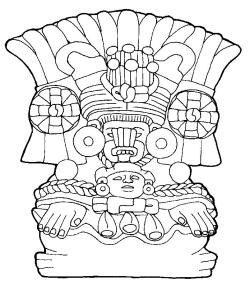
Key:  AM 61-16
Actual Location:  Atkins Museum (Nelson Gallery ), Kansas City, United States.
Collection:  
Registration:  61-16
Provenance:  Monte Albán, Oaxaca.
Measurements:  63.5 cm.
Color:  Light grey clay
Chronology:  MA IIIA (Boos 1966b: 61); Pitao 350 - 500 d.C.  Click to view Chronology
Reference:  Boos 1966b: 61, plate 41; Stendahl 1968: 189, fig. 236.
Comments:  Person holds a staff in the right hand and a bag of incense in the left hand.
Glyphs:  The owl's mask in the headdress. Correspondence with glyph F.
Dating:  

Click to view high resolution in a new window
select this image for review

Key:  AMNH 30.0/8
Actual Location:  American Museum of Natural History, New York, United States.
Collection:  Marshall H. Saville
Registration:  30.0/8
Provenance:  Cuilapan, Oaxaca
Measurements:  22 x 26 cm.
Color:  Light grey clay
Chronology:  Pitao 350 - 500 AD  Click to view Chronology
Reference:  Boos 1964a: 77, plate II.
Comments:  Probably a headdress fragment from a large effigy vessel. Corresponds to the butterfly.
Glyphs:  
Dating:  

Click to view high resolution in a new window
select this image for review

Key:  AMNH 30/136
Actual Location:  American Museum of Natural History, New York, United States
Collection:  Manuel Martínez Gracida 1894; Eduard Seler 1896
Registration:  30/136, acc. 1896-20
Provenance:  San Lázaro Zautla, Oaxaca.
Measurements:  34 x 28 cm.
Color:  White sandstone with traces of red pigment.
Chronology:  Pitao 350 - 500 AD  Click to view Chronology
Reference:  Drawing by Sabino Soriano, in the unpublished work of Manuel Martínez Gracida, second volume, Stone Idols and Statues, 1910: plate 72.
Comments:  Described as "stone statue" and made of basalt. According to Martínez Gracida, this statue was found in a grave, in the year 1894. It was Etla's Political Chief, Agustín Robles Arenas, who gave it to him as a present. The head joins to the body via a hole in each part.
Glyphs:  Mask of glyph U.
Dating:  

Click to view high resolution in a new window
select this image for review

Key:  BARAKAT 2
Actual Location:  Barakat Gallery, Beverly Hills, California, United States
Collection:  
Registration:  
Provenance:  Unknown
Measurements:  
Color:  Covered in red pigment.
Chronology:  Pitao 350 - 500 AD  Click to view Chronology
Reference:  Http://www.barakatgallery.com/store
Comments:  Seated figure wearing a Cocijo mask. The pectoral plate is a curious version of the "milpa" glyph, given that the three dots in the center are placed vertically. Most glyphs of this type have the dots placed horizontally.
Glyphs:  The glyph for "cornfield" constitutes the pectoral plate. In the headdress there is a large glyph C.
Dating:  

Click to view high resolution in a new window
select this image for review

Key:  BELMAR 2
Actual Location:  Museo Nacional de Antropología, Mexico City, Mexico
Collection:  Francisco Belmar #38
Registration:  
Provenance:  Monte Albán, Oaxaca
Measurements:  
Color:  Grey
Chronology:  Pitao 350 - 500 AD  Click to view Chronology
Reference:  Caso and Bernal 1952: 133, fig. 218.
Comments:  According to Belmar he personally found this object at the site of Monte Albán.
Glyphs:  
Dating:  

Click to view high resolution in a new window
select this image for review

Key:  BM 1
Actual Location:  British Museum, London, England
Collection:  Constantino Rickards
Registration:  
Provenance:  Unknown
Measurements:  21 cm.
Color:  Grey clay with traces of white paint.
Chronology:  Pitao 350 - 500 AD  Click to view Chronology
Reference:  3 photos from Rickards of the piece in his house; Mexican Art, 1953: fig. 17 (exhibition number: 298).
Comments:  The posture adopted by this human figure suggests that he represents a ball game player. For other objects with similar posture see: DAM 1971.0350, SLAM 171.1979, SMA 1. For other possible representations of ball players see: MFR 1233, MNA 6-6061, SMI 19506.
Glyphs:  
Dating:  

Click to view high resolution in a new window
select this image for review

Key:  BM 1849/6-29/28
Actual Location:  British Museum, London, England.
Collection:  John Wetherall
Registration:  1849/6-29/28
Provenance:  Unknown
Measurements:  18 cm.
Color:  Light orange-yellow clay.
Chronology:  Pitao 350 - 500 AD  Click to view Chronology
Reference:  Boos 1964a: 86-87, plate VII.
Comments:  A butterfly head in the headdress.
Glyphs:  
Dating:  

Click to view high resolution in a new window
select this image for review

Key:  BM 1908/7-8/18
Actual Location:  British Museum, London, England.
Collection:  Alfred Maudslay
Registration:  1908/7-8/18
Provenance:  Santa Inés de Acechi, Oaxaca.
Measurements:  5.7 cm.
Color:  
Chronology:  Pitao 350 - 500 AD  Click to view Chronology
Reference:  
Comments:  Boos 1966a: 234, fig. 213.
Glyphs:  The mask and attire correspond to glyph X.
Dating:  

Click to view high resolution in a new window
select this image for review

Key:  BMC 503-11
Actual Location:  Unknown
Collection:  Barbier-Mueller
Registration:  Inv. 503-11
Provenance:  Unknown
Measurements:  51.8 cm.
Color:  
Chronology:  Pitao 350 - 500 AD  Click to view Chronology
Reference:  1985 Catalog of the Edward Merrin Gallery: fig. 45; Pre-Columbian Art in the Barbier-Mueller Collection, 1994: plate 58, pages 255 and 356.
Comments:  A bird's wing in the headdress. A bag of incense above the ear pieces. Some iconographic details coincide with piece MNA 6-834, such as the frame of the corn field glyph.
Glyphs:  
Dating:  

Click to view high resolution in a new window
select this image for review

Key:  BMS 15997
Actual Location:  Buffalo Museum of Science, Buffalo, United States.
Collection:  
Registration:  C 15997/Acc. 47151
Provenance:  Ejutla, Oaxaca
Measurements:  47.5 x 52.5 cm.
Color:  Grey clay
Chronology:  Pitao 350 - 500 AD  Click to view Chronology
Reference:  Dollero 1911: 813; Boos 1966b: 126, fig. 108; Winter 1994: 146.
Comments:  According to a note published by Dollero (1911: 813), this piece comes from Ejutla and this author lets us guess that it was part of an exhibition in town. Part of the glyphic information got loose from the cartouche. The cartouche hangs from the owl's neck. This piece was bought in 1947 by Berkely Galleries (personal communication with Kevin Smith, Curator for Mesoamerica, Buffalo Science Museum, 1998).
Glyphs:  The owl's mask in the headdress represents glyph F.
Dating:  

Click to view high resolution in a new window
select this image for review

Go to Page:   1 2 3 4 5 6 7 8 9 10 11 12 13 14 15 16 17 18 19