FAMSI Research Materials


572 records searched.


Click on any image to view in high resolution.
Click the checkboxes and the 'review selections' button to view images with captions in a printable format.
Results 1 - 10 of 18 for "niza"
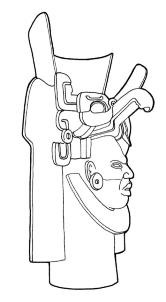
Key:  CHILA 1
Actual Location:  Unknown
Collection:  
Registration:  
Provenance:  Bajos de Chila, Oaxaca.
Measurements:  22 x 15 cm.
Color:  Headdress with graffito paint.
Chronology:  Niza 100 BC - 200 AD  Click to view Chronology
Reference:  
Comments:  This piece was found by Donald Brockington in 1969, while travelling through the coast of Oaxaca. It was associated with stelae number one in the archaeological site of Chila (Brockington et al. 1974: 58-62). The piece was covered with a big plate decorated in black and red. The drawing is based on Jorrín (1974). In a letter from Brockington to Philippa Shaplin (01/19/76), the archaeologist established phase MA II or II-IIIA Transition.
Glyphs:  
Dating:  

Click to view high resolution in a new window
select this image for review

Key:  CMA 54.857
Actual Location:  Cleveland Museum of Art, Ohio, United States.
Collection:  Donated by the Hanna Fund, 1954.
Registration:  54.857
Provenance:  Unknown
Measurements:  32.3 cm.
Color:  Brown polished clay with traces of red pigment.
Chronology:  Niza 100 BC - 200 AD  Click to view Chronology
Reference:  Milliken 1955: 60; Easby and Scott 1970: fig. 155.
Comments:  Known as the "Scribe of Cuilapan" because it resembles a Chinese scribe. There is another almost identical piece at the Museum of Cultures in Oaxaca, but which is slightly taller. See MCO 1170.
Glyphs:  Glyph 13 water in the headdress and 13 Q (flint) on the chest.
Dating:  

Click to view high resolution in a new window
select this image for review

Key:  EMB 39743
Actual Location:  Ethnographic Museum (Ethnologisches Museum), Berlin, Germany.
Collection:  E. Johannssen 1927
Registration:  IV Ca. 39743
Provenance:  Monte Albán, Oaxaca.
Measurements:  47.5 x 13.7 cm.
Color:  Dark grey clay.
Chronology:  Niza 100 BC - 200 AD  Click to view Chronology
Reference:  Schuler-Schömig 1970: 30, plate 1.
Comments:  Early representation of a Cocijo. Although the TL study by Goedicke et al. 1992 maintain that this object is a fake, my opinion, based on the object's iconography and signs of wear and breakage, is that the piece is authentic.
Glyphs:  The glyph C in the headdress is one of its kind.
Dating:  TL by Goedicke et al. 1992, test no. 1: not authentic (no date).

Click to view high resolution in a new window
select this image for review

Key:  MAM 1
Actual Location:  Amparo Museum, Puebla, Mexico.
Collection:  Josué Sáenz
Registration:  
Provenance:  Unknown
Measurements:  Aprox. 9 cm.
Color:  Beige
Chronology:  Niza 100 BC - 200 AD  Click to view Chronology
Reference:  
Comments:  For a comparison with a similar piece, in terms of style, see ROM 1945.
Glyphs:  Glyph C in the headdress.
Dating:  

Click to view high resolution in a new window
select this image for review

Key:  MCO 0012
Actual Location:  Museum of Cultures of Oaxaca, City of Oaxaca, Mexico (exhibited).
Collection:  José Juan Canseco 1850
Registration:  Cat. 0012/INAH 10-104350
Provenance:  Zaachila (Peñafiel 1893: 24) ; Mitla (F. León 1903?: 115); Cuilapan (N. León 1905: 403).
Measurements:  33.5 x 17.5 cm.
Color:  Polished brown clay with traces of red pigment.
Chronology:  Niza 100 BC - 200 AD  Click to view Chronology
Reference:  Peñafiel 1893: 24-25; Calderón León 1903?: 115 [description]; Nicolás León, Mayan Hieroglyphs, 1896 & 1905: 403, plate 1, fig. 1; Caso 1928 (reproduction of the glyphs); Keleman 1943: vol. II, plate 123 d; Toscano 1944: 432; Covarrubias 1946: fig. 18; C
Comments:  There is a head with the same properties as this piece (cf. Caso and Bernal, 1952: 337, fig. 500bis). There is also a complete piece at the Cleveland Museum (CMA 54.857). About the pieces, Caso and Bernal comment: "We do not know if we should include it with the figures of period II, because we have not found in Monte Albán, during our stratigraphic explorations, any objects of this style and the two that exist come from the old collections of the National Museum and the Museum of Oaxaca" (1952: 337). It was always said that this piece came from Cuilapan, but it seems to have been a mistake from León, as from the very beginning, it was established that its provenance was Zaachila.
Glyphs:  Glyph 13 for water in the headdress and 13 Q on the chest. Bernal (1979: 103) interprets the glyphs as 13 water and 13 alligator's eye.
Dating:  

Click to view high resolution in a new window
select this image for review

Key:  MCO s/n 3
Actual Location:  Museum of Cultures of Oaxaca, City of Oaxaca, Mexico (exhibited).
Collection:  
Registration:  
Provenance:  Unknown
Measurements:  
Color:  
Chronology:  Niza 100 BC - 200 AD  Click to view Chronology
Reference:  
Comments:  
Glyphs:  A glyph C in the headdress.
Dating:  

Click to view high resolution in a new window
select this image for review

Key:  MFR 1361
Actual Location:  Frissell Museum, Mitla, Mexico.
Collection:  
Registration:  MFR CC-1361 / INAH 3200
Provenance:  Unknown
Measurements:  36.5 x 23 cm.
Color:  
Chronology:  Niza 100 BC - 200 AD  Click to view Chronology
Reference:  
Comments:  Effigy of Cocijo.
Glyphs:  The hairpin glyph decorates the garments.
Dating:  F76

Click to view high resolution in a new window
select this image for review

Key:  MFR 1983
Actual Location:  Frissell Museum, Mitla, Mexico.
Collection:  
Registration:  MFR 1983 / INAH 2732
Provenance:  Unknown. San Dionisio?
Measurements:  27 x 21 cm.
Color:  Light grey clay.
Chronology:  Niza 100 BC - 200 AD  Click to view Chronology
Reference:  Example of an early Cocijo effigy.
Comments:  
Glyphs:  
Dating:  F18

Click to view high resolution in a new window
select this image for review

Key:  MNA 6-450
Actual Location:  National Anthropology Museum, Mexico City, Mexico.
Collection:  
Registration:  6-450
Provenance:  Cuilapan, Oaxaca.
Measurements:  34 cm.
Color:  
Chronology:  MA II (Caso and Bernal, 1952: 33); Niza 100 BC - 200 AD  Click to view Chronology
Reference:  Caso and Bernal 1952: 32, fig. 32.
Comments:  Human figure with Cocijo mask.
Glyphs:  
Dating:  

Click to view high resolution in a new window
select this image for review

Key:  MNA 6-5801
Actual Location:  National Anthropology Museum, Mexico City, Mexico.
Collection:  
Registration:  MNA cat. 6-5801/ Inv. 10-61343.
Provenance:  Tomb 77, no. 26, Monte Albán, Oaxaca.
Measurements:  81.5 x 66 cm.
Color:  Painted in blue, yellow, white and red.
Chronology:  MA II (Caso and Bernal 1952: 202); Niza 100 BC - 200 AD  Click to view Chronology
Reference:  Caso 1935: 26-27; Keleman 1943: vol. II, plate 121c; Toscano 1944: 429; Caso & Bernal 1952: 202-203, figs. 341, 341 bis; Covarrubias 1957: plate XXXIV; Paddock 1966: 124, fig. 80; Gendrop 1970: 137, fig. 158b; Pre-Columbian Art 1990: 151, fig. 52.
Comments:  This piece was found by Alfonso Caso in the period PMA IV (1934-1935). According to Caso and Bernal, the piece is an early expression of the "God with Head Piece of a Wide-Beaked Bird" (1952: 204). Flannery and Marcus believe that the urn represents a warrior because, according to them, the head piece worn by the figure is a bird of prey (1996: 199). See also MNA t/77, no. 3.
Glyphs:  
Dating:  

Click to view high resolution in a new window
select this image for review

Go to Page:   1 2