FAMSI Research Materials


572 records searched.


Click on any image to view in high resolution.
Click the checkboxes and the 'review selections' button to view images with captions in a printable format.
Results 1 - 10 of 72 for "cocijo"
Key:  AMNH 30.0/1
Actual Location:  American Museum of Natural History, New York, United States
Collection:  Mrs. Robert W. De Forest. Donated 8 April 1904.
Registration:  30.0/1; Acc. 1904-25.
Provenance:  Found in a mound, near a tomb, in the valley of Oaxaca, Winter 1903-1904.
Measurements:  
Color:  Beige clay with traces of red pigment in the mask in the headress (teeth)
Chronology:  Xoo 600 - 800 AD  Click to view Chronology
Reference:  Saville 1904: 51, photo p. 50.
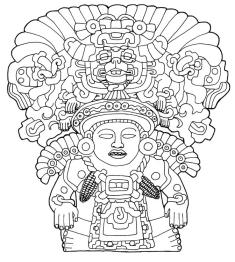
Comments:  This figure represents a woman holding a shield and a club. The mask in the headddress represents Cocijo. The piece was probably found with AMNH 30.0/4, a bat figure with the same headdress.
Glyphs:  
Dating:  

Click to view high resolution in a new window
select this image for review

Key:  BARAKAT 2
Actual Location:  Barakat Gallery, Beverly Hills, California, United States
Collection:  
Registration:  
Provenance:  Unknown
Measurements:  
Color:  Covered in red pigment.
Chronology:  Pitao 350 - 500 AD  Click to view Chronology
Reference:  Http://www.barakatgallery.com/store
Comments:  Seated figure wearing a Cocijo mask. The pectoral plate is a curious version of the "milpa" glyph, given that the three dots in the center are placed vertically. Most glyphs of this type have the dots placed horizontally.
Glyphs:  The glyph for "cornfield" constitutes the pectoral plate. In the headdress there is a large glyph C.
Dating:  

Click to view high resolution in a new window
select this image for review

Key:  BELMAR 1
Actual Location:  Unknown, probably National Museum of Anthropology in Mexico.
Collection:  Francisco Belmar (#37?)
Registration:  
Provenance:  Unknown
Measurements:  
Color:  
Chronology:  MA IIIB (Boos 1966b: 79); Xoo 600 - 800 AD.  Click to view Chronology
Reference:  Boos 1966: 79, fig. 58.
Comments:  
Glyphs:  The glyph M (Cocijo) in the headdress is displayed on both sides of the same mask with a front view. Possibly two bars of five attached to the Cocijo's nose: 10?M. A glyph C in the headdress.
Dating:  

Click to view high resolution in a new window
select this image for review

Key:  CB 8
Actual Location:  Bustamante Vasconcelos Foundation, Oaxaca City, Oaxaca, Mexico.
Collection:  Mr. Manuel J. Bustamante Vasconcelos
Registration:  
Provenance:  Unknown
Measurements:  26 x 27 cm.
Color:  
Chronology:  Peche 500 - 600 AD  Click to view Chronology
Reference:  
Comments:  Compare with MNA 6-636 and MFR 3745. The missing part could have been either a Cocijo face or the glyph for corn.
Glyphs:  
Dating:  

Click to view high resolution in a new window
select this image for review

Key:  CMA 44.78
Actual Location:  Cleveland Museum of Art, Ohio, United States.
Collection:  Donation from the Eastman Family.
Registration:  44.78
Provenance:  Unknown
Measurements:  37 x 26.5 cm.
Color:  Light brown clay.
Chronology:  MA IIIA (Boos 1966b: 74); Pitao 350 - 500 AD  Click to view Chronology
Reference:  Boos 1966b: 74, fig. 53.
Comments:  The pectoral and part of the headdress are missing from this piece. For other examples, see MNA 6-635, EMB 24882, MFVV 55.158, MDO 32 and MFR s/n 1. For an analysis of this type, see Sellen 2002: 9.
Glyphs:  Glyph C in headdress flanked by two ears of corn. Cocijo mask in the headdress (glyph M).
Dating:  

Click to view high resolution in a new window
select this image for review

Key:  CPA 5
Actual Location:  Anonymous private collection in Mexico
Collection:  
Registration:  
Provenance:  Unknown
Measurements:  
Color:  
Chronology:  Pitao 350 - 500 AD  Click to view Chronology
Reference:  Boos 1966: 78, fig. 576.
Comments:  This human figure wears a headdress with a Cocijo mask. On both sides of the headdress, strips with alligator eyes can be seen.
Glyphs:  
Dating:  

Click to view high resolution in a new window
select this image for review

Key:  DAM 1974.0328
Actual Location:  Denver Art Museum, Denver , Colorado, United States.
Collection:  
Registration:  
Provenance:  Unknown
Measurements:  
Color:  
Chronology:  Tani 200 - 350 AD  Click to view Chronology
Reference:  
Comments:  Urn of Cocijo.
Glyphs:  
Dating:  

Click to view high resolution in a new window
select this image for review

Key:  DAM 1977.186
Actual Location:  Denver Art Museum, Denver , Colorado, United States.
Collection:  
Registration:  
Provenance:  Unknown
Measurements:  Aprox. 70 cm.
Color:  
Chronology:  Peche 500 - 600 AD  Click to view Chronology
Reference:  
Comments:  Great urn of Cocijo.
Glyphs:  Glyph C in the headdress.
Dating:  

Click to view high resolution in a new window
select this image for review

Key:  EMB 11156
Actual Location:  Ethnographic Museum (Ethnologisches Museum), Berlin, Germany.
Collection:  Edward Seler 1890
Registration:  IV Ca. 11156
Provenance:  Zaachila, Oaxaca
Measurements:  18.2 cm.
Color:  Grey clay with red pigment.
Chronology:  Xoo 600 - 800 AD  Click to view Chronology
Reference:  Seler 1904b: plate XXXIII; Schuler-Schömig 1970: 46, plate 35.
Comments:  Pot with pouring handle decorated with a Cocijo face. According to the information published by Edward Seler, he himself witnessed the excavation of this piece in Zaachila, which came out with other pieces of a ceramics assemblage.
Glyphs:  The hairpin glyph decorates one of the vessel's tubes.
Dating:  TL by Goedicke et al. 1992, test No. 35: authentic (TL's date: A.C. 1273-1343).

Click to view high resolution in a new window
select this image for review

Key:  EMB 11159
Actual Location:  Ethnographic Museum (Ethnologisches Museum), Berlin, Germany.
Collection:  Edward Seler 1890
Registration:  IV Ca.11159
Provenance:  Zaachila, Oaxaca
Measurements:  17.3 cm.
Color:  Grey clay with red pigment.
Chronology:  Xoo 600 - 800 AD  Click to view Chronology
Reference:  Seler 1904a: 354, plate 85; Seler 1904b: plate XXXIII; Schuler-Schömig 1970: 47, plate 36.
Comments:  Pot with pouring handle decorated with Cocijo face. According to the information published by Edward Seler, he himself witnessed the excavation of this piece in Zaachila, which came out with other pieces next to a ceramics dowry.
Glyphs:  The hairpin glyph decorates one of the vessel's tubes.
Dating:  TL by Goedicke et al. 1992, test No. 36: authentic (TL's date: A.C. 1150-1235).

Click to view high resolution in a new window
select this image for review

Go to Page:   1 2 3 4 5 6 7 8