FAMSI Research Materials


572 records searched.


Click on any image to view in high resolution.
Click the checkboxes and the 'review selections' button to view images with captions in a printable format.
Results 21 - 30 of 72 for "cocijo"
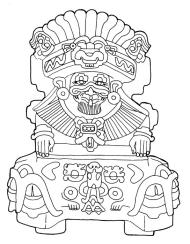
Key:  MA t/104
Actual Location:  Monte Albán, built in the facade of tomb 104.
Collection:  
Registration:  
Provenance:  Monte Albán, Oaxaca.
Measurements:  91 cm.
Color:  Grey clay
Chronology:  Peche 500 - 600 AD  Click to view Chronology
Reference:  Caso 1938: 73 and 76, fig. 92; Caso and Bernal 1952: 51, fig. 72.
Comments:  The figure holds a bag of incense in one hand and the other hand is stretched out. This hand was mutilated by a tourist a few years back. In 1938, Caso identified this piece as Pitao Cozobi or God of Corn, but later, together with Bernal, they decide to classify it, in their work of 1952, as the "God with Cocijo Head in Headdress". The headdress mask belongs to the Xicani and is flanked by two jaguar heads.
Glyphs:  
Dating:  

Click to view high resolution in a new window
select this image for review

Key:  MACP A-0295
Actual Location:  Museum of Archaeology Carlos Pellicer, Villahermosa, Tabasco, Mexico
Collection:  
Registration:  A-0295
Provenance:  Unknown
Measurements:  
Color:  Beige clay
Chronology:  Xoo 600 - 800 AD  Click to view Chronology
Reference:  
Comments:  Bottle for with a stamped-out Cocijo face.
Glyphs:  
Dating:  

Click to view high resolution in a new window
select this image for review

Key:  MCO 2702
Actual Location:  Museum of Cultures of Oaxaca, City of Oaxaca, Mexico (exhibited).
Collection:  
Registration:  2702
Provenance:  In front of the entrance to tomb 7, Monte Albán, Oaxaca.
Measurements:  
Color:  
Chronology:  Xoo 600 - 800 AD  Click to view Chronology
Reference:  Caso 1932a: 19-20, fig. 32; Caso 1932b: 466-467; Caso & Bernal 1952: 44, figs. a, b, c; Bernal 1979: 144, fig. 52.
Comments:  This piece was found flanked by two pieces of lid and box, but the lids of the other two pieces are different, as they represent the Cocijo. Caso and Bernal identified the human figure of the illustrated urn as "The God of Corn" (1952: 46). The three pieces were found broken and, according to Caso (1932: 20), the position of the two fragments proves that the break was intentional and that, after doing so, the objects were buried. Caso excavated tomb 7 in the first PMA I period (1931-1932).
Glyphs:  Glyph C in the headdress flanked by two ears of corn.
Dating:  

Click to view high resolution in a new window
select this image for review

Key:  MCO Of. In. del Templo X
Actual Location:  Museum of Cultures of Oaxaca, City of Oaxaca, Mexico (exhibited).
Collection:  
Registration:  
Provenance:  Offering inside Temple X, Monte Albán, Oaxaca.
Measurements:  50 cm.
Color:  Grey clay
Chronology:  Transition (Caso and Bernal, 1952: 34); Tani 200 - 350 AD  Click to view Chronology
Reference:  Caso and Bernal 1952: 33-34, fig. 33.
Comments:  Human figure with Cocijo mask. Alligator eyes decorate the loincloth.
Glyphs:  
Dating:  

Click to view high resolution in a new window
select this image for review

Key:  MCSJM 1
Actual Location:  Community Museum, San José Mogote, Oaxaca, Mexico.
Collection:  
Registration:  
Provenance:  San José Mogote, Oaxaca.
Measurements:  
Color:  
Chronology:  Pe 300 - 100 BC  Click to view Chronology
Reference:  
Comments:  Brazier of a human figure with Cocijo face. In the headdress, we can see the mask of a being with the nose rolled up backwards and, above it, a glyph C. The glyph C is not engraved, but it is possible that the details were applied with paint.
Glyphs:  Glyph C in the headdress.
Dating:  

Click to view high resolution in a new window
select this image for review

Key:  MCT 2
Actual Location:  Civic Museum of Turin, Italy.
Collection:  Zaverio Calpini , circa 1876; Callegari gives an earlier date 1864 (1931: 514).
Registration:  
Provenance:  Nochistlán o Xoxocotlán (Callegari 1931: 514).
Measurements:  23.5 cm.
Color:  
Chronology:  Pitao 350 - 500 AD  Click to view Chronology
Reference:  Africa, America, Australasia: the Ethnological Collections, Civic Museum of Turin, 1978: 66, fig. 17.
Comments:  
Glyphs:  In the headdress, glyph M "Cocijo", seen sideways. Beside the jaw, numeral 1 (1 M).
Dating:  

Click to view high resolution in a new window
select this image for review

Key:  MDO 32
Actual Location:  Dolores Olmedo Museum, Mexico City, México (exhibited).
Collection:  Fernando Sologuren; Armilia Van Rijn (195?-1964); Dolores Olmedo Patiño (presently).
Registration:  Record from the National Anthropology and History Institute (INAH) , P.F. 100, LO 32
Provenance:  Probably Etla, Oaxaca
Measurements:  51 x 46 cm.
Color:  Dark grey clay
Chronology:  Pitao 350 - 500 AD  Click to view Chronology
Reference:  Caso & Bernal 1952: 98, fig. 163; Boos 1966b: 65; 50-peso bill circa 1973; Eubanks 1999: 137-138, fig. 110; Sellen 2002: 9, fig. 5e y 11, fig. 8.
Comments:  This piece was probably found by Fernando Sologuren at the beginning of last century. In 1928, Caso and Bernal (1952: 97) took pictures of the piece when it was at Mercedes Sologuren's house. At the beginning of the 1950s, the piece went to Machida Armilia Van Rijn and then, in 1964, it was acquired by Dolores Olmedo Patiño (personal communication Patricia Van Rijn, 1999). For other types, see MNA 6-635, cm.A 44.78, MFVV 55.158, EMB 24882 and MFR s/n 1. For an analysis of this type, see Sellen 2002: 9. For the same Etla style, see MDO 33 and MFR 12619.
Glyphs:  Glyph C in the headdress flanked by two glyphs of small plants and then, two glyphs for corn. The figure in the headdress corresponds to the Cocijo (glyph M).
Dating:  

Click to view high resolution in a new window
select this image for review

Key:  MES 23.8.307
Actual Location:  Swedish Ethnographic Museum, Stockholm, Sweden.
Collection:  August Edwin Paulson
Registration:  23.8.307
Provenance:  Tuxtepec, Oaxaca.
Measurements:  37.9 x 31.9 cm.
Color:  Front part in red. Traces of green paint.
Chronology:  Peche 500 - 600 AD  Click to view Chronology
Reference:  Linné 1938: 160, plate 31.
Comments:  The piece has been partially restored. According to Linné, it was wearing a Cocijo mask.
Glyphs:  Glyph J in the headdress. Two alligator eyes in the throne's back and above these, two glyphs for sprouted corn.
Dating:  

Click to view high resolution in a new window
select this image for review

Key:  MFR 1224
Actual Location:  Frissell Museum, Mitla, Mexico
Collection:  
Registration:  Cat. 1224
Provenance:  
Measurements:  
Color:  
Chronology:  Pitao 350 - 500 AD  Click to view Chronology
Reference:  
Comments:  Cocijo effigy. This piece has a contraparte in the Royal Ontario Museum (see ROM 1953) and the Ethnographic Museum of Berlin (see EMB 26836)
Glyphs:  5 dots in the headdress. Object is missing the corresponding glyph.
Dating:  

Click to view high resolution in a new window
select this image for review

Key:  MFR 12583
Actual Location:  Frissell Museum, Mitla, Mexico.
Collection:  
Registration:  MFR 12583 / INAH 3263
Provenance:  Unknown
Measurements:  50 x 38 cm.
Color:  Grey clay
Chronology:  Peche 500 - 600 AD  Click to view Chronology
Reference:  
Comments:  This figure is missing the head and part of the left hand. However, we can see that it was carrying a bag of incense in this hand. The right hand is stretched out, palm up.
Glyphs:  The face of an owl is tied to the right arm and glyph M (Cocijo) to the left arm.
Dating:  F57

Click to view high resolution in a new window
select this image for review

Go to Page:  1 2  3 4 5 6 7 8