FAMSI Resources


Logo
570 records searched.


Results 21 - 35 of 35 for "jaguar"
Key:  CB 1
Actual Location:  Bustamante Vasconcelos Foundation, Oaxaca City, Oaxaca, Mexico.
Collection:  Mr. Manuel J. Bustamante Vasconcelos
Provenance:  Unknown
Measurements:  42 x 30 cm.
Color:  Traces of red pigment on face.
Chronology:  Peche 500 - 600 AD
  Click to view Chronology
Comments:  From one side of the headdress, a jaguar head sticks out, next to a plaited cord. The human figure is wearing a cape decorated with small dots and is holding a bag of incense.

Click to view high resolution in a new window
select this image for review

Key:  CB 10
Actual Location:  Bustamante Vasconcelos Foundation, Oaxaca City, Oaxaca, Mexico.
Collection:  Mr. Manuel J. Bustamante Vasconcelos
Provenance:  Unknown
Measurements:  19 x 22 cm.
Color:  Light grey clay.
Chronology:  Pe 300 - 100 BC
  Click to view Chronology
Comments:  Double vessel with a pouring spout. A jaguar decorates the first vessel.

Click to view high resolution in a new window
select this image for review

Key:  WM 1961.37
Actual Location:  Worchester Museum, Massachusetts, United States.
Collection:  Aldus Chapin Higgins
Registration:  1961.37
Provenance:  Monte Albán?
Measurements:  38 cm.
Color:  Grey clay with red pigment
Chronology:  Xoo 600 - 800 AD
  Click to view Chronology
Reference:  Drawing based on an unpublished picture from Shaplin.
Comments:  Compare with urn UD T/7 Dainzú. It is also the representation of a woman and has the same glyph and coefficient.
Glyphs:  Numeral 1 and a jaguar's head (glyph B) in the headdress (1B).

Click to view high resolution in a new window
select this image for review

Key:  MFR 12641
Actual Location:  Frissell Museum, Mitla, Mexico.
Registration:  MFR 12641 / INAH 3317
Provenance:  Tlacochahuaya, Oaxaca.
Measurements:  74 x 42 cm.
Color:  Grey clay
Chronology:  Peche 500 - 600 AD
  Click to view Chronology
Comments:  This figure's right hand is stretched out, palm up, which most probably means that it was holding a bag of incense in the left hand, as this is typical in this type of posture. In the center of the headdress, a large jaguar head.
Glyphs:  In the piece's pedestal, the glyph for corn field, framed by the glyph for hill.
Dating:  F6

Click to view high resolution in a new window
select this image for review

Key:  MNA 6-395
Actual Location:  National Anthropology Museum, Mexico City, Mexico.
Collection:  Fernando Sologuren
Registration:  6-395
Provenance:  San Martín, Oaxaca [?]
Measurements:  18 cm.
Chronology:  Peche 500 - 600 AD
  Click to view Chronology
Reference:  Caso and Bernal 1952: 82, fig. 132.
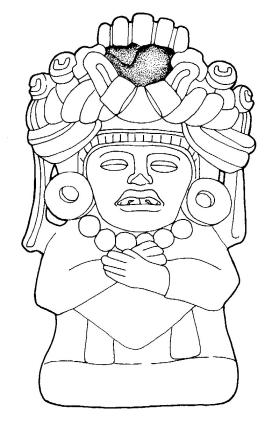
Comments:  Caso and Bernal (1952: 82) say: "An urn has 4 beads in the headdress instead of 2, as if to say that the name of the goddess is 4 J instead of 2 J. The goddess is represented in a sitting position, with the hands on her chest, in an attitude that is characteristic of the urns of period IIIA. In spite of this anomaly, we believe that it is the same goddess". In a photo from the E. Seler Collection, this piece is illustrated when it was part of the Sologuren Collection. The missing part is a jaguar's head.
Glyphs:  Four numerals decorating the braids in the headdress and a jaguar's head in the center (missing) (4 B).

Click to view high resolution in a new window
select this image for review

Key:  MARI M.26.7
Actual Location:  Mesoamerican Research Institute, Tulane University, New Orleans (warehouse).
Registration:  M.26.7
Provenance:  Unknown
Measurements:  8 cm.
Color:  Grey clay
Chronology:  Peche 500 - 600 AD
  Click to view Chronology
Comments:  Jaguar head that was probably attached to a brazier's rim. See Bustamante Collection (CB 2).

Click to view high resolution in a new window
select this image for review

Key:  ROM 563
Actual Location:  Royal Ontario Museum, Toronto, Canada.
Collection:  Constantino Rickards
Registration:  HM 563
Provenance:  La Mixteca, Oaxaca.
Measurements:  14 cm.
Color:  Brown
Chronology:  Xoo 600 - 800 AD
  Click to view Chronology
Comments:  Representation of an old jaguar or a dog.

Click to view high resolution in a new window
select this image for review

Key:  SLAM 175:1979
Actual Location:  Saint Louis Art Museum, Saint Louis, Missouri, United States.
Collection:  Morton D. May
Registration:  175:1979/ former loan number 1970.728
Provenance:  Unknown
Measurements:  38 cm.
Color:  Grey clay
Chronology:  Xoo 600 - 800 AD
  Click to view Chronology
Reference:  Parsons 1980: 146, fig. 226.
Comments:  Effigy of a human figure wearing a jaguar skin. The way in which the vessel is attached to the back is unusual.
Dating:  Shaplin and Zimmerman, TL no. 3 (700 rads, authentic).

Click to view high resolution in a new window
select this image for review

Key:  MFR 1473
Actual Location:  Frissell Museum, Mitla, Mexico.
Collection:  Howard Leigh
Registration:  MFR 1473
Provenance:  Mixteca Alta?
Measurements:  36 x 26.5 cm.
Color:  Red, white, blue and yellow paint.
Chronology:  Xoo 600 - 800 AD?
  Click to view Chronology
Comments:  Paddock says in a letter to Philippa Shaplin (30/04/76) that this piece was carrying a vessel on its back and was used as a brazier. He also speculates that it comes from the Mixteca Alta, so it is possible that it was not made by the Zapotecs. Paddock believes that the piece was painted after it was fired, just like the piece that was found by Bernal in Magdalena Jicotlán (MNA 6-7892). The human figure has a jaguar in the headdress and some element was hanging from the ear pieces, but are now missing. See CBE 56 for a similar image of a jaguar on the headdress.

Click to view high resolution in a new window
select this image for review

Key:  UD T/7 Dainzú
Actual Location:  Unknown
Provenance:  Tomb 7, Dainzú, Oaxaca.
Color:  Traces of red pigment in the head.
Chronology:  MA IIIA (Bernal 1976: 297-298); Pitao 350 - 500 AD
  Click to view Chronology
Reference:  Bernal 1976: 297, fig. 3.
Comments:  Bernal (1976: 297) comments that this piece looks like another one published by Caso and Bernal, which comes from Backyard I, Well 2-R in Atzompa (1952, Fig. 436) because of the type of headdress and the way in which the hands are placed on the chest. It is even more similar to piece WM 1961.37 because it has the same glyph, 1B. The shape under the numeral is not truthfully represented because the published photo of the piece is not very clear.
Glyphs:  Numeral 1 and a jaguar (glyph B) between the legs (1B).

Click to view high resolution in a new window
select this image for review

Key:  EMB 11394
Actual Location:  Ethnographic Museum (Ethnologisches Museum), Berlin, Germany.
Collection:  Seler 1887 and 1888
Registration:  IV Ca. 11394
Provenance:  Mitla, Oaxaca.
Measurements:  28 cm. de largo. Tubo 7 cm. dia
Color:  Brown clay with traces of white stucco and red pigment.
Chronology:  Xoo 600 - 800 AD
  Click to view Chronology
Comments:  This piece was probably used as a drain because it is shaped like a tube. A rectangular opening on the top means that the liquid would have run down the sides of the alligator or serpent's head . A human figure comes out of its jaws and the nose of this supernatural being is a jaguar's head.

Click to view high resolution in a new window
select this image for review

Key:  SOTH 1994.129
Actual Location:  Unknown
Collection:  Sotheby Parke Bennet Auction
Provenance:  Unknown
Measurements:  20.3 cm.
Color:  Grey clay
Chronology:  Pitao 350 - 500 AD
  Click to view Chronology
Reference:  Auction's catalog, Sotheby's 1994: fig. 129.
Glyphs:  Two glyphs B (jaguar) in the headdress, crowned with glyph J (corn). On both sides of the headdress, there are S-shaped glyphs that could represent clouds. In the middle of the headdress, glyph C and the glyph for corn field as pectoral.

Click to view high resolution in a new window
select this image for review

Key:  FASF 119477
Actual Location:  Fine Arts Museum of San Francisco, San Francisco, United States
Collection:  Danted by Patrick and Lauren Hallinan
Registration:  Cat. 119477 / Acc. no. 1986.66.2
Provenance:  unknown
Measurements:  34.9 x 43 cm
Color:  Grey clay
Chronology:  Pitao 350 - 500 AD
  Click to view Chronology
Reference:  CAMIO online images.
Comments:  This jaguar wears a collar with a six pointed plate. Each point is perforated at the end. Compara with MNA 6-68 that comes from a controlled archaeological context.
Glyphs:  It has the coefficient one on the neck below the mouth. 1B?

Click to view high resolution in a new window
select this image for review

Key:  CBE 56
Actual Location:  Unknown location
Collection:  Louis Gustave Bellon
Registration:  Col. Bellon no. 56
Provenance:  Magdalena Apasco, District of Etla, Oaxaca
Chronology:  Peche 500 - 600 AD
  Click to view Chronology
Reference:  Photograph en the archive of Marshall H. Saville, American Museum of Natural History, box 27.
Comments:  Drawing based on a black and white photograph. An element is missing the center of the headdress, where it was adhered to the braid. Possibly this was a glyph C or perhaps a coefficient that accompanied one of the glyphs. A jaguar rests on top of the headdress, and this is a rare, but for a similar image see MFR 1473.

Click to view high resolution in a new window
select this image for review

Key:  UBM CO1354
Actual Location:  Übersee Museum of Bremen, Germany.
Collection:  Kluckhom-Stallforth (Dr. P. Kluckhom 1821, F.W. Stallforth 1921)
Registration:  CO1354
Provenance:  Unknown
Color:  Grey clay
Chronology:  Pitao 350 - 500 AD
  Click to view Chronology
Reference:  König and Kröfges 2001: 99
Comments:  Although this object is not an "urn" we include it here because it is a type of effigy with a container. The bird sitting on top of this box is most probably a turkey (guajalote in Mexico) evident by the absence of feathers on the head and a fleshy protuberance that hangs from the top of its beak called a snood. The head of the bird has been perforated, perhaps for purposes of adding additional decoration or to place a cord through the object.
Glyphs:  The glyph 6 Jaguar is inscribed in white on the front of the box. The glyph for "cloud" on one side of the bird.

Click to view high resolution in a new window
select this image for review

Go to Page:  1 2 3