FAMSI Resources


Logo
570 records searched.


Results 11 - 25 of 35 for "jaguar"
Key:  ROM 373
Actual Location:  Royal Ontario Museum, Toronto, Canada.
Collection:  Constantino Rickards
Registration:  HM 373
Provenance:  Santa Cruz Mixtepec, Ocotlán District, Oaxaca.
Measurements:  18 cm.
Color:  Grey clay with a beige coating.
Chronology:  Xoo 600 - 800 AD
  Click to view Chronology
Comments:  This jaguar head is similar to another at the Smithsonian Institution, which is more complete (SMI 115034).
Glyphs:  Glyph # 109 on the head's crown (broken).
Dating:  TL by Lazos, Ortiz, Ruvalcaba and Sellen, 1999, test #090313: authentic.

Click to view high resolution in a new window
select this image for review

Key:  BM 1946/AM/19/5
Actual Location:  British Museum, London, England.
Registration:  1946/AM/19/5
Provenance:  Tyllo, Oaxaca.
Measurements:  32 cm.
Color:  Cream with light grey coating.
Chronology:  Peche 500 - 600 AD
  Click to view Chronology
Reference:  Boos 1966b: 406, fig. 374.
Comments:  The figure is holding a non-identified object in the hands. However, it could be a bag of incense. It wears a mouth jaguar mask and has rosettes in the headdress. There is also a plaited cord in the headdress, on the left side.

Click to view high resolution in a new window
select this image for review

Key:  MFR s/n 3
Actual Location:  Unknown (before at Frissell Museum).
Provenance:  Unknown
Measurements:  54 cm.
Chronology:  MA IV (Boos 1966a: 63); Xoo 600 - 800 AD
  Click to view Chronology
Reference:  Boos 1966a: 63, fig. 43; Paddock 1966: 148, fig. 150.
Comments:  This figure is holding a type of staff in the left hand and a shield in the right arm. A bag of incense, with the head of an animal, probably a jaguar, hangs from the headdress. Bags of this type feature in headdresses of human figures carved on jambs in San Lázaro Zautla (cf. Urcid 1991: 10). Behind the bag is the head of a bird, perhaps a quetzal, placed on one side. In December 1959, while this piece was being taken to an exhibition, the transport car had an accident near Huitzo. It was stolen from the scene of the accident and never recovered.

Click to view high resolution in a new window
select this image for review

Key:  MFR 1244
Actual Location:  Frissell Museum, Mitla, Mexico.
Collection:  Howard Leigh
Registration:  1244
Provenance:  Unknown
Measurements:  39 cm.
Color:  Beige
Chronology:  Peche 500 - 600 AD
  Click to view Chronology
Reference:  Boos 1966b: 289, fig. 267; Urcid 1993: 159, fig. 12.
Comments:  Great effigy of a jaguar.
Glyphs:  Glyph U in the headdress, surrounded by leaves (glyph 109).

Click to view high resolution in a new window
select this image for review

Key:  NMAI 195806
Actual Location:  National Museum of the American Indian, Smithsonian Institution, Washington, D.C., United States.
Collection:  Martin (1845); Eugène Boban (1870); E. Goupil (1888); George Gustave Heye (1922)
Registration:  Old number from MAI 19/5806. New number from NMAI 195806.000
Provenance:  Close to Mitla, Oaxaca.
Measurements:  72 x 35 cm.
Color:  Light grey clay with traces of red pigment.
Chronology:  MA IIIB (Boos 1966b: 304); Pitao 350 - 500 AD
  Click to view Chronology
Reference:  Boban 1886: 19 (drawing); Nature, 1889: 120, fig. 2; Dockstader 1964: fig. 53; Boos 1966b: 304, fig. 283, Boos 1969: 133, fig. 1.
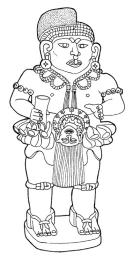
Comments:  This piece was taken to France in 1845 by French Consul Martin. Eugène Boban purchased it in 1870 and tried to sell it, unsuccessfully, to the Smithsonian Institution in 1887. He ended up selling it to E. Goupil around 1888. Later, George Heye bought it in an auction in France and took it to his museum in New York. This human figure is holding a jaguar vase in one hand. There is no object in the other hand, but the gesture indicates he once held something. A trophy head hangs from his collar piece that is made up of human maxillae. The piece looks like MFVV 55163 and fragment MFR 1233. It may represent a young ball-game player with his head shaved.

Click to view high resolution in a new window
select this image for review

Key:  MFR 1322
Actual Location:  Frissell Museum, Mitla, Oaxaca, Mexico.
Collection:  Howard Leigh (date of purchase: 1950)
Registration:  1322 / INAH 3068 (National Anthropology and History Institute)
Provenance:  Sola de la Vega, Oaxaca.
Measurements:  19.7 x 34.6 x 25.5 dia. cm.
Color:  Grey clay with traces of red.
Chronology:  MA IIIA (Boos 1966b: 399); Pitao 350 - 500 AD
  Click to view Chronology
Reference:  Boos 1966b: 399, fig. 366
Comments:  Upper part of a brazier. Some restoration work with wax can be observed.
Glyphs:  Glyph U above jaguar's head. 6 numerals, but one could be missing (7? U).

Click to view high resolution in a new window
select this image for review

Key:  CPA 6
Actual Location:  Anonymous private collection in Mexico.
Collection:  Kurt Stavenhagen
Registration:  ST-L9-0101
Provenance:  Unknown
Chronology:  Xoo 600 - 800 AD
  Click to view Chronology
Reference:  Boos 1966b: 285, fig. 263.
Comments:  Effigy of a jaguar.
Glyphs:  The glyph epsilon, or "blood," in the corners of the mouth.

Click to view high resolution in a new window
select this image for review

Key:  MNA 6-4842
Actual Location:  National Anthropology Museum, Mexico City, Mexico.
Collection:  Guillermo Dupaix
Registration:  6-42
Provenance:  Mitla, Oaxaca.
Measurements:  47 cm.
Color:  Grey clay with traces of white and red paint. Face painted in red.
Chronology:  Peche 500 - 600 AD
  Click to view Chronology
Reference:  Gumesindo & Sánchez 1882: 465, no. 1 (catalog description); Seler 1904: 302, plate XXXVI; Galindo & Villa 1905: plate 26; Mexican masks, 1945, p. 50, fig. 43; Mexican Art 1953: fig. 20; Covarrubias 1957: plate XXXV; Romero 1958: plate XL. The richness
Comments:  According to the information provided by Edward Seler, this piece was found by explorer Dupaix at the beginning of the 19th century, in Mitla. Jaguar headdress and in the jaguar's forehead, a bird's head. Another bird head hangs from a pendant. The piece has no feet and was probably used as the lid of another container.
Glyphs:  Two glyphs for heart on both sides of the headdress.

Click to view high resolution in a new window
select this image for review

Key:  MCS 2
Actual Location:  Community Museum, Suchiquiltongo, Oaxaca, Mexico.
Provenance:  Tomb 5, Cerro de la Campana (Hill of the Bell), Oaxaca
Chronology:  Xoo 600 - 800 AD
  Click to view Chronology
Comments:  A standing effigy of a dog or old jaguar. On the right hand, we can see fragments of a rope.

Click to view high resolution in a new window
select this image for review

Key:  SMI 115149
Actual Location:  Smithsonian Institution, Washington D.C., United States.
Collection:  Manuel Ortega Reyes; Louis H. Ayme. Acquired by the Museum on 29 July 1885.
Registration:  Cat. 115149; Acc. No. 16290
Provenance:  Zaachila, Oaxaca.
Measurements:  29 x 24.5 cm.
Color:  Light grey clay.
Chronology:  Xoo 600 - 800 AD
  Click to view Chronology
Reference:  Von Müller 1864: 82, fig. II; Boos 1966: 483, fig. 457 (Boos identified the piece with the wrong catalog number, i.e. 115148).
Comments:  Representation of a dog or maybe, an old jaguar. The human figure holds a bag of incense in the hands.

Click to view high resolution in a new window
select this image for review

Key:  CB 1
Actual Location:  Bustamante Vasconcelos Foundation, Oaxaca City, Oaxaca, Mexico.
Collection:  Mr. Manuel J. Bustamante Vasconcelos
Provenance:  Unknown
Measurements:  42 x 30 cm.
Color:  Traces of red pigment on face.
Chronology:  Peche 500 - 600 AD
  Click to view Chronology
Comments:  From one side of the headdress, a jaguar head sticks out, next to a plaited cord. The human figure is wearing a cape decorated with small dots and is holding a bag of incense.

Click to view high resolution in a new window
select this image for review

Key:  CB 10
Actual Location:  Bustamante Vasconcelos Foundation, Oaxaca City, Oaxaca, Mexico.
Collection:  Mr. Manuel J. Bustamante Vasconcelos
Provenance:  Unknown
Measurements:  19 x 22 cm.
Color:  Light grey clay.
Chronology:  Pe 300 - 100 BC
  Click to view Chronology
Comments:  Double vessel with a pouring spout. A jaguar decorates the first vessel.

Click to view high resolution in a new window
select this image for review

Key:  WM 1961.37
Actual Location:  Worchester Museum, Massachusetts, United States.
Collection:  Aldus Chapin Higgins
Registration:  1961.37
Provenance:  Monte Albán?
Measurements:  38 cm.
Color:  Grey clay with red pigment
Chronology:  Xoo 600 - 800 AD
  Click to view Chronology
Reference:  Drawing based on an unpublished picture from Shaplin.
Comments:  Compare with urn UD T/7 Dainzú. It is also the representation of a woman and has the same glyph and coefficient.
Glyphs:  Numeral 1 and a jaguar's head (glyph B) in the headdress (1B).

Click to view high resolution in a new window
select this image for review

Key:  MFR 12641
Actual Location:  Frissell Museum, Mitla, Mexico.
Registration:  MFR 12641 / INAH 3317
Provenance:  Tlacochahuaya, Oaxaca.
Measurements:  74 x 42 cm.
Color:  Grey clay
Chronology:  Peche 500 - 600 AD
  Click to view Chronology
Comments:  This figure's right hand is stretched out, palm up, which most probably means that it was holding a bag of incense in the left hand, as this is typical in this type of posture. In the center of the headdress, a large jaguar head.
Glyphs:  In the piece's pedestal, the glyph for corn field, framed by the glyph for hill.
Dating:  F6

Click to view high resolution in a new window
select this image for review

Key:  MNA 6-395
Actual Location:  National Anthropology Museum, Mexico City, Mexico.
Collection:  Fernando Sologuren
Registration:  6-395
Provenance:  San Martín, Oaxaca [?]
Measurements:  18 cm.
Chronology:  Peche 500 - 600 AD
  Click to view Chronology
Reference:  Caso and Bernal 1952: 82, fig. 132.
Comments:  Caso and Bernal (1952: 82) say: "An urn has 4 beads in the headdress instead of 2, as if to say that the name of the goddess is 4 J instead of 2 J. The goddess is represented in a sitting position, with the hands on her chest, in an attitude that is characteristic of the urns of period IIIA. In spite of this anomaly, we believe that it is the same goddess". In a photo from the E. Seler Collection, this piece is illustrated when it was part of the Sologuren Collection. The missing part is a jaguar's head.
Glyphs:  Four numerals decorating the braids in the headdress and a jaguar's head in the center (missing) (4 B).

Click to view high resolution in a new window
select this image for review

Go to Page:  1 2 3