FAMSI Resources


Logo
570 records searched.


Results 51 - 65 of 179 for "xoo"
Key:  COWD 1
Actual Location:  Unknown
Collection:  Vice- Earl of Cowdray
Provenance:  Unknown
Measurements:  34 cm.
Chronology:  MA IV (Boos 1966b: 343); Xoo 600 - 800 AD
  Click to view Chronology
Reference:  Boos1966b: 343, fig. 314.
Comments:  There is doubt on the authenticity of this piece. (See ROM 1944).

Click to view high resolution in a new window
select this image for review

Key:  ROM 1396
Actual Location:  Royal Ontario Museum, Toronto, Canada
Collection:  Constantino Rickards
Registration:  HM 1396 / 917.4.41
Provenance:  without provenance
Measurements:  33.5 cm.
Color:  Dark grey clay with vestiges of green.
Chronology:  Xoo 600 - 800 AD
  Click to view Chronology
Reference:  Boos 1964: plate IV; Boos 1966: 83, fig. 63.
Comments:  A very similar piece exists in the Museé du quay Branly in Paris, but the bird face in the headdress is replaced with glyph E (cf. MQB 87.101.47).
Glyphs:  In the headdress the glyph F is placed over the glyph C.
Dating:  UNAM test #100364: authentic

Click to view high resolution in a new window
select this image for review

Key:  YUAG 29.19.1958
Actual Location:  Yale University Art Gallery (lent by Fred Olsen).
Collection:  Acquision 1903. Originally from Enrique Juan Palacios, Reg. #6 (INAH); Fred Olsen.
Registration:  29.19.1958 (Eubanks gives number 1973.88.10. Why two numbers? Are there two pieces?)
Provenance:  Unknown
Measurements:  44.5 cm.
Color:  Traces of paint.
Chronology:  MA IIIB (Boos 1966b: 185, Eubanks 1999: 117); Xoo 600 - 800 AD
  Click to view Chronology
Reference:  Boos 1966b: 185, fig. 164; Eubanks 1999: 117-118, fig. 93.
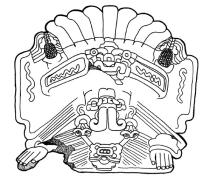
Comments:  This piece is one of a series. The total number of pieces in the series is unknown, but there are at least two. The other piece is published in an auction's catalog (Parke-Bennet Galleries, 23 May 1970, fig. 76). The auction's piece is identical, except for a frame of volutes behind the figure. It is very likely that the piece of the Olsen Collection had this frame as well, but it fell off at some point and that is why the piece has been herein reproduced with the reconstructed volutes. Compare with MNA 6-6754.
Glyphs:  Glyph C in the headdress flanked by two ears of corn.

Click to view high resolution in a new window
select this image for review

Key:  BELMAR 1
Actual Location:  Unknown, probably National Museum of Anthropology in Mexico.
Collection:  Francisco Belmar (#37?)
Provenance:  Unknown
Chronology:  MA IIIB (Boos 1966b: 79); Xoo 600 - 800 AD.
  Click to view Chronology
Reference:  Boos 1966: 79, fig. 58.
Glyphs:  The glyph M (Cocijo) in the headdress is displayed on both sides of the same mask with a front view. Possibly two bars of five attached to the Cocijo's nose: 10?M. A glyph C in the headdress.

Click to view high resolution in a new window
select this image for review

Key:  MNA 6-6031
Actual Location:  National Museum of Anthropology, Mexico City, Mexico
Registration:  Cat. 6-6031 / INAH 10-221992
Provenance:  Unknown
Measurements:  30 x 30.5 cm.
Color:  Grey clay
Chronology:  Xoo 600 - 800 AD
  Click to view Chronology
Comments:  This object was documented while on loan to the Arqueological Museum, Carlos Pellicer Cámara, in Villahermosa, Tabasco. The piece is missing a large part of its headdress, which has been intentionally cut off, as can be seen by the marks around the glyph C.
Glyphs:  The glyph C in thye headdress.

Click to view high resolution in a new window
select this image for review

Key:  MDO 55
Actual Location:  Dolores Olmedo Museum, Mexico City, Mexico (exhibited).
Collection:  Fernando Sologuren
Registration:  Record from the National Anthropology and History Institute (INAH), P.F. 100, LO 55
Provenance:  Unknown
Measurements:  14 x 10.5 cm.
Chronology:  Xoo 600 - 800 AD
  Click to view Chronology
Comments:  The piece appears on a shelf of the Sologuren Collection, as shown by a photograph at the Ibero-American Institute, Seler Collection, box 69 "Mixteca u, Tzapoteco Alterhümer II". An effigy like this one was found as an offering on the dintel of tomb 6, mound 195, in Lambityeco. See photograph under Lind 2003: 53, fig. 10.
Glyphs:  The Epsilon "blood" glyph in the corners of the mouth.

Click to view high resolution in a new window
select this image for review

Key:  CPA 6
Actual Location:  Anonymous private collection in Mexico.
Collection:  Kurt Stavenhagen
Registration:  ST-L9-0101
Provenance:  Unknown
Chronology:  Xoo 600 - 800 AD
  Click to view Chronology
Reference:  Boos 1966b: 285, fig. 263.
Comments:  Effigy of a jaguar.
Glyphs:  The glyph epsilon, or "blood," in the corners of the mouth.

Click to view high resolution in a new window
select this image for review

Key:  MFVM 10.3493
Actual Location:  Museum für Völkerkunde, Munich, Germany.
Collection:  Fernando Sologuren 1880?
Registration:  10.3493
Provenance:  La Ciénega, District of Zimatlán, Oaxaca (Peñafiel 1893: 20) Mitla, Oaxaca (Boos 1966b: 294).
Measurements:  7.7 x 16 cm.
Color:  Grey clay
Chronology:  Xoo 600 - 800 AD
  Click to view Chronology
Reference:  Peñafiel 1893: 20; Martínez Gracida 1910: plate 39; Woeller 1960: plate 27; Boos 1966b: 294, figs. 272, 273, 274; Urcid 1993: 159, fig. 13.
Comments:  According to Martínez Gracida, this piece comes from La Ciénaga of Zimatlán, but a label on the piece says that it comes from Mitla. The piece has several details in the lower part.

Click to view high resolution in a new window
select this image for review

Key:  MNA Ent. VI-7
Actual Location:  National Anthropology Museum, Mexico City, Mexico.
Provenance:  Burial VI-7, Monte Albán, Oaxaca.
Measurements:  8 cm.
Chronology:  Xoo 600 - 800 AD
  Click to view Chronology
Reference:  Caso and Bernal 1952: 42, fig. 52a.
Glyphs:  Glyph C in the headdress. Five reproductions of the glyph for corn grain.

Click to view high resolution in a new window
select this image for review

Key:  MFR 1822
Actual Location:  Frissell Museum, Mitla, Mexico.
Collection:  Ervin Frissell
Registration:  MFR CC-1822 /INAH 2778
Provenance:  Unknown
Measurements:  21 x 15.5 cm.
Color:  Light grey clay
Chronology:  Xoo 600 - 800 AD
  Click to view Chronology
Reference:  Paddock 1968: 19, fig. 27.
Comments:  Pot with double pouring handles and Cocijo face.
Glyphs:  Glyph C in the headdress. The hairpin glyph decorates the vessel.

Click to view high resolution in a new window
select this image for review

Key:  MNA 6-1203
Actual Location:  National Anthropology Museum, Mexico City, Mexico.
Registration:  6-1203
Provenance:  Ejutla, Oaxaca.
Measurements:  20 cm.
Chronology:  Xoo 600 - 800 AD
  Click to view Chronology
Reference:  Caso and Bernal 1952: 25, fig. 18.
Comments:  Globular pot with double pouring handles and stamped Cocijo face.
Glyphs:  Glyph C in the headdress. The hairpin glyph decorates the pot and the pouring handles.

Click to view high resolution in a new window
select this image for review

Key:  AMNH 30/6334
Actual Location:  American Museum of Natural History, New York, United States.
Collection:  Marshall H. Saville
Registration:  30/6334
Provenance:  Tomb 3, Mound 9, Xoxocotlán, Oaxaca.
Measurements:  47.5 x 55 cm.
Color:  Beige ceramic paste with traces of red.
Chronology:  MA IIIB (Eubanks 1999: 134); Xoo 600 - 800 AD
  Click to view Chronology
Reference:  Saville 1899, 358-359, 1904: 54-56, photos on pages 54 (in situ) and 56 (with box) ;Eubanks 1999: 134-135, fig. 108. There is an unpublished drawing by Urcid of the pieces in situ on the facade.
Comments:  This piece is part of a series of five pieces excavated by Marshall Saville. He found them embedded over a lintel engraved with glyphs, at the entrance of a tomb. On both sides of the central vessel, there were two stucco skulls embedded in the facade (see Urcid's reconstruction). Each urn was protected with a plate when the tomb was buried. They are lids and Saville (1899: 359) maintains that he found the matching boxes, broken and thrown into the fill that was used to cover the tomb. The pieces were broken when they were dettached from the facade.
Glyphs:  A glyph C in the headdress.

Click to view high resolution in a new window
select this image for review

Key:  MNA 6-6708
Actual Location:  National Anthropology Museum, Mexico City, Mexico.
Registration:  8-6
Provenance:  La Mixteca, Oaxaca.
Measurements:  13 x 11. 3 cm.
Color:  Brown clay.
Chronology:  MA IV (Eubanks 1999: 128-129); Xoo 600 - 800 AD
  Click to view Chronology
Reference:  Eubanks 1999: 128-129, fig. 102-103.
Comments:  Pot with two pouring handles. The handles have the shape of an ear of corn. Possibly the ends with circles in the headdress, which are mostly broken, represent grains of corn as shown by other vessels of this type. Compare with MFR 4279 and MNA 6-682.
Glyphs:  Glyph C in the headdress.

Click to view high resolution in a new window
select this image for review

Key:  AMNH 30.0/3
Actual Location:  American Museum of Natural History, New York, United States.
Collection:  Mrs. Robert W. De Forest. Donated in April 1904.
Registration:  30.0/3
Provenance:  Found in a mound in the Valley of Oaxaca.
Measurements:  37.5 x 25 cm.
Chronology:  Xoo 600 - 800 AD
  Click to view Chronology
Reference:  Saville 1904: 51, photo on p. 50; Eubanks 1999: 125-126, fig. 100.
Comments:  Saville reported that it was found with 5 other pieces, all of them different. It is possible that the corn representation in the center of the headdress was added on a later date, as this glyph is usually placed on both sides of the headdress.

Click to view high resolution in a new window
select this image for review

Key:  MNA 6-682
Actual Location:  National Anthropology Museum, Mexico City, Mexico.
Collection:  Fernando Sologuren #553
Registration:  6-682 (catalog number 6-6885 reported in Eubanks, 1999: 143).
Provenance:  Etla, Oaxaca.
Measurements:  12.2 x 11.4 cm.
Color:  Dark grey clay.
Chronology:  MA IV (Eubanks 1999: 143); Xoo 600 - 800 AD
  Click to view Chronology
Reference:  Seler's drawing circa 1888; Caso and Bernal 1952: 107-108, fig. 176; Eubanks 1999: 142-143, fig. 115.
Comments:  Pot with two pouring handles. The handles have the shape of an ear of corn. Because of the two ears of corn, Caso and Bernal maintain that "[this piece] definitely connects this God with Bow in the Headdress to the God of Corn" (Caso and Bernal 1952: 108). Compare with MNA 6-6708 and MFR 4279.

Click to view high resolution in a new window
select this image for review

Go to Page:  1 2 3 4 5 6 7 8 9 10 11 12