FAMSI Resources


Logo
570 records searched.


Results 141 - 154 of 154 for "peche"
Key:  SMI 215075
Actual Location:  Smithsonian Institution, Washington D.C., United States.
Registration:  215075
Provenance:  Atzompa, Oaxaca.
Color:  Grey clay.
Chronology:  Peche 500 - 600 AD
  Click to view Chronology
Glyphs:  Two glyphs 109 in the headdress, one is broken. The piece corresponds to glyph Ñ.

Click to view high resolution in a new window
select this image for review

Key:  MFR 1845
Actual Location:  Frissell Museum, Mitla, Mexico.
Provenance:  Unknown
Chronology:  Peche 500 - 600 AD
  Click to view Chronology
Comments:  Human figure with a bird in the headdress, possibly a turkey buzzard. For similar pieces, compare with MNA 6-799, MNA 6-798 and MFVV 6087. This piece was probably used as a brazier's lid.
Dating:  F9

Click to view high resolution in a new window
select this image for review

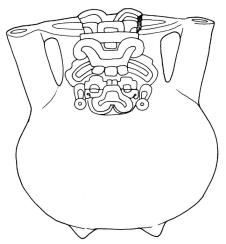
Key:  MNA t/103, antecámara
Actual Location:  National Anthropology Museum, Mexico City, Mexico.
Provenance:  Antechamber of tomb 103, Monte Albán, Oaxaca.
Measurements:  20 cm.
Chronology:  Peche 500 - 600 AD
  Click to view Chronology
Reference:  Caso and Bernal 1952: 40, fig. 17 (drawing).
Comments:  This piece, a pot with two pouring handles, decorated in front with a Cocijo head, was found in the antechamber of tomb 103. Next to this piece, an effigy vessel representing a female human figure (MNA 6-4852), a cylindrical polished black glass and a few fragments of earthenware with fresco polychromed decorations were found. The tomb was excavated by Caso in the sixth period (1937). For a very similar ceramic set, see EMB 11157, EMB 11158, EMB 11159 and EMB 11156.

Click to view high resolution in a new window
select this image for review

Key:  MCO 10-104807
Actual Location:  Museum of Cultures of Oaxaca, City of Oaxaca, Mexico (warehouse).
Registration:  10-104807 / 6-760 (Caso and Bernal 1952: 189)
Provenance:  Unknown
Measurements:  26.5 x 20 cm.
Color:  Grey clay with traces of white stucco.
Chronology:  Peche 500 - 600 AD
  Click to view Chronology
Reference:  Caso and Bernal 1952: 189, fig. 318.
Glyphs:  The face corresponds to glyph X.

Click to view high resolution in a new window
select this image for review

Key:  MFVH 3645
Actual Location:  Museum für Volkerkunde und Vorgesshichte, Hamburg, Germany.
Registration:  B3645
Provenance:  Unknown
Chronology:  Peche 500 - 600 AD
  Click to view Chronology
Reference:  Drawing based on a photo at the Ibero-American Institute, Seler Collection, box 73.
Glyphs:  Glyph 1 P in the headdress. On both sides of the head, in the headdress, the epsilon or "blood" glyph can be seen.

Click to view high resolution in a new window
select this image for review

Key:  MNA 6-400
Actual Location:  National Anthropology Museum, Mexico City, Mexico.
Collection:  Fernando Sologuren #455
Provenance:  San Juan Teitipac, Oaxaca.
Measurements:  29 cm.
Chronology:  Peche 500 - 600 AD
  Click to view Chronology
Reference:  Caso and Bernal 1952: 286, fig. 435.
Comments:  According to a photograph of the Seler Collection at the Ibero-American Institute, we know that this piece was part of Fernando Sologuren's collection.

Click to view high resolution in a new window
select this image for review

Key:  MNA Mont. YW ofrenda 2-2
Actual Location:  National Anthropology Museum, Mexico City, Mexico.
Provenance:  Mound YW, well 1, offering 2, No. 2, Monte Albán, Oaxaca.
Measurements:  19 x 14.5 cm.
Chronology:  Peche 500 - 600 AD
  Click to view Chronology
Reference:  Caso et al. 1967: 126, fig. 79a.
Comments:  Caso found this urn in an excavation of mound YW (fifth period 1936) next to another urn (MCO 0679) which were both covered with broken pieces of earthenware (potsherds) and flat stones to protect them.

Click to view high resolution in a new window
select this image for review

Key:  MNA Patio t.104
Actual Location:  National Anthropology Museum, Mexico City, Mexico.
Provenance:  Courtyard of tomb 104, Monte Albán, Oaxaca.
Measurements:  26 cm.
Chronology:  Peche 500 - 600 AD
  Click to view Chronology
Reference:  Caso and Bernal 1952: 285, fig. 432.
Comments:  Caso and Bernal (1952: 283) say: "...[the figure] bears a serpent eye in the headdress, as well as a few beads of jade, decorated as numerals, in the shape of number 11, which was probably 13; among them, a bead of authentic jade". Because of the bad quality of the photo presented, these details cannot be observed.
Glyphs:  The glyph for alligator eye (V) in the headdress.

Click to view high resolution in a new window
select this image for review

Key:  MFR s/n 6
Actual Location:  Frissell Museum, Mitla, Mexico.
Provenance:  Unknown
Measurements:  18.5 cm.
Color:  Grey clay
Chronology:  Peche 500 - 600 AD
  Click to view Chronology
Comments:  Drawing based on a photo from Philippa Shaplin. Compare with ROM 1936, KERR 6460, SMI 115002, UPM 29-41-707 and MCO 0679.

Click to view high resolution in a new window
select this image for review

Key:  MACP A-0285
Actual Location:  Museum of Archaeology Carlos Pellicer, Villahermosa, Tabasco, Mexico
Registration:  A-0285
Provenance:  unknown
Color:  Beige clay with vestiges of white pigment.
Chronology:  Peche 500 - 600 AD
  Click to view Chronology
Comments:  This piece could have been a companion to other similar objects.

Click to view high resolution in a new window
select this image for review

Key:  MACP B-0342
Actual Location:  Museum of Archaeology Carlos Pellicer, Villahermosa, Tabasco, Mexico
Collection:  Fernando Sologuren
Registration:  B-0342
Provenance:  Zautla, Etla (Peñafiel 1893: 13); Nazareno (Caso y Bernal 1952: 109) Oaxaca.
Color:  Grey with vestiges of red pigment.
Chronology:  Peche 500 - 600 AD
  Click to view Chronology
Comments:  Effigy of an incense bag tied with slip knot decorated with bows. A piece that looks exactly like this one is held at the National Anthropology Museum in Mexico City (cf. MNA 6-1600), but it is slightly more complete. Therefore there must have been at least two objects in the same series. The origen of the object is in doubt given that there are two versions of its provenance. Compare with MFR 2540, MFR 8898 and MH 24.13.3663.
Glyphs:  The glyph ñ.

Click to view high resolution in a new window
select this image for review

Key:  CBE 56
Actual Location:  Unknown location
Collection:  Louis Gustave Bellon
Registration:  Col. Bellon no. 56
Provenance:  Magdalena Apasco, District of Etla, Oaxaca
Chronology:  Peche 500 - 600 AD
  Click to view Chronology
Reference:  Photograph en the archive of Marshall H. Saville, American Museum of Natural History, box 27.
Comments:  Drawing based on a black and white photograph. An element is missing the center of the headdress, where it was adhered to the braid. Possibly this was a glyph C or perhaps a coefficient that accompanied one of the glyphs. A jaguar rests on top of the headdress, and this is a rare, but for a similar image see MFR 1473.

Click to view high resolution in a new window
select this image for review

Key:  CBE 145
Actual Location:  Present location unknown
Collection:  Louis Gustave Bellon
Registration:  no. 145
Provenance:  San Pablo Huitzo, Oaxaca
Chronology:  Peche 500 - 600 AD
  Click to view Chronology
Reference:  Photograph in the archive of Marshall H. Saville, American Museum of Natural History, box 27.
Comments:  Drawing based on a black and white photograph. Effigy of a woman with a large glyph J in her headdress. The figure is missing the right hand and large part of its base.
Glyphs:  The glyph for corn (J) in the headdress and inserted into the collar the number three (3J). However, under the the glyph J there is number bar for 5, so the coefficient may sum 8.

Click to view high resolution in a new window
select this image for review

Key:  NMAI 180086
Actual Location:  National Museum of the American Indian, Smithsonian Institution
Collection:  Louis Gustave Bellon; George Heye (donated 1931)
Registration:  Col. Bellon no. 301; NMAI cat. 180086.000
Provenance:  Zaachila, Center District, Oaxaca
Measurements:  45 x 41 cm.
Color:  Grey clay
Chronology:  Peche 500-600 AD
  Click to view Chronology
Reference:  Photograph of the piece in the Bellon collection in the archive of Marshall H. Saville, American Museum of Natural History, box 27.
Comments:  In September 1894 Martínez Gracida found this piece in a grave next to three other identical objects. Soon after he sold the objects: One to Luis Reynaud, two to Lucio Smith, and one to Eduard Seler along with the rest of his collection. Today there are two identical artefacts in the Smithsonian Institution but they are not complete (see SMI 198426 and SMI 198427). These come from Lucio Smith via E. W. Nelson. There is a more complete object in the Peabody Museum (see PMAE 10609) that was gift from the AMNH in 1929. This was the urn donated by Seler in 1895. The fourth piece, the urn purchased by Luis Reynaud, ended up in the Bellon collection. George Heye bought the object at auction in Paris in 1928 or 1929.
Glyphs:  The glyph C in the headdress. Based on the more complete objects, it also hade the glyph epsilon hanging from the ears.

Click to view high resolution in a new window
select this image for review

Go to Page:  1 2 3 4 5 6 7 8 9 10 11