FAMSI Resources


Logo
570 records searched.


Results 51 - 65 of 106 for "maize or corn"
Key:  AMNH 30.0/3
Actual Location:  American Museum of Natural History, New York, United States.
Collection:  Mrs. Robert W. De Forest. Donated in April 1904.
Registration:  30.0/3
Provenance:  Found in a mound in the Valley of Oaxaca.
Measurements:  37.5 x 25 cm.
Chronology:  Xoo 600 - 800 AD
  Click to view Chronology
Reference:  Saville 1904: 51, photo on p. 50; Eubanks 1999: 125-126, fig. 100.
Comments:  Saville reported that it was found with 5 other pieces, all of them different. It is possible that the corn representation in the center of the headdress was added on a later date, as this glyph is usually placed on both sides of the headdress.

Click to view high resolution in a new window
select this image for review

Key:  MNA 6-682
Actual Location:  National Anthropology Museum, Mexico City, Mexico.
Collection:  Fernando Sologuren #553
Registration:  6-682 (catalog number 6-6885 reported in Eubanks, 1999: 143).
Provenance:  Etla, Oaxaca.
Measurements:  12.2 x 11.4 cm.
Color:  Dark grey clay.
Chronology:  MA IV (Eubanks 1999: 143); Xoo 600 - 800 AD
  Click to view Chronology
Reference:  Seler's drawing circa 1888; Caso and Bernal 1952: 107-108, fig. 176; Eubanks 1999: 142-143, fig. 115.
Comments:  Pot with two pouring handles. The handles have the shape of an ear of corn. Because of the two ears of corn, Caso and Bernal maintain that "[this piece] definitely connects this God with Bow in the Headdress to the God of Corn" (Caso and Bernal 1952: 108). Compare with MNA 6-6708 and MFR 4279.

Click to view high resolution in a new window
select this image for review

Key:  MNA 6-6754
Actual Location:  National Anthropology Museum and Museum of Cultures, Mexico City, Mexico.
Registration:  6-54
Provenance:  Antechamber of tomb 31, Monte Albán, Oaxaca.
Measurements:  30 x 26.7 cm.
Color:  Grey clay.
Chronology:  Xoo 600 - 800 AD
  Click to view Chronology
Reference:  Caso and Bernal 1952: 93 & 99, fig. 99; Romero 1958: 184; plate XXXVII; Eubanks 1999: 109-110, fig. 86.
Comments:  This piece is one of a series of five identical pieces. Caso found them in the period PMA II (1932-1933) in front of the entrance to the tomb, which was dated MA IIIB-IV. Two complete pieces came out of the excavation: one is exhibited at the National Anthropology Museum and the other is exhibited at the Museum of Cultures. Compare with YUAG 29.19.1958.
Glyphs:  Glyph C in the headdress. The glyph for corn field in the pectoral. Hairpin glyphs decorate the loincloth.

Click to view high resolution in a new window
select this image for review

Key:  MNA 6-6062
Actual Location:  National Anthropology Museum, Mexico City, Mexico (exhibited).
Registration:  6-62
Provenance:  Zaachila, Oaxaca.
Color:  Grey clay
Chronology:  Xoo 600 - 800 AD
  Click to view Chronology
Glyphs:  A glyph C in the headdress. The glyph for corn field in the pectoral.

Click to view high resolution in a new window
select this image for review

Key:  MNA 6-6223
Actual Location:  National Anthropology Museum, Mexico City, Mexico.
Registration:  23-6
Provenance:  Tomb 124, Monte Albán, Oaxaca.
Measurements:  34 x 29 cm.
Color:  Grey clay
Chronology:  Xoo 600 - 800 AD
  Click to view Chronology
Reference:  Caso & Bernal 1952: 93, fig. 153; Eubanks 1999: 105, fig. 82 (another of the same series, more complete).
Glyphs:  Glyph C in the headdress. The glyph for corn field in the pectoral. Hairpin glyphs decorate the loincloth.

Click to view high resolution in a new window
select this image for review

Key:  MCO 2702
Actual Location:  Museum of Cultures of Oaxaca, City of Oaxaca, Mexico (exhibited).
Registration:  2702
Provenance:  In front of the entrance to tomb 7, Monte Albán, Oaxaca.
Chronology:  Xoo 600 - 800 AD
  Click to view Chronology
Reference:  Caso 1932a: 19-20, fig. 32; Caso 1932b: 466-467; Caso & Bernal 1952: 44, figs. a, b, c; Bernal 1979: 144, fig. 52.
Comments:  This piece was found flanked by two pieces of lid and box, but the lids of the other two pieces are different, as they represent the Cocijo. Caso and Bernal identified the human figure of the illustrated urn as "The God of Corn" (1952: 46). The three pieces were found broken and, according to Caso (1932: 20), the position of the two fragments proves that the break was intentional and that, after doing so, the objects were buried. Caso excavated tomb 7 in the first PMA I period (1931-1932).
Glyphs:  Glyph C in the headdress flanked by two ears of corn.

Click to view high resolution in a new window
select this image for review

Key:  JB 13
Actual Location:  Unknown
Collection:  Former private collection of Jules Berman.
Registration:  cat. 13
Provenance:  Unknown
Measurements:  22.9 cm.
Chronology:  Xoo 600 - 800 AD
  Click to view Chronology
Reference:  Jules Berman Collection of Mexican Pre-Columbian Art, 1973, fig. 13; Sotheby's auction catalog of June 2, 1999, page 68, fig. 132.
Comments:  The figure is wearing a Cocijo mask.
Glyphs:  Glyph C in the headdress and the glyph for corn field as pectoral.

Click to view high resolution in a new window
select this image for review

Key:  MNA 6-248
Actual Location:  National Anthropology Museum, Mexico City, Mexico.
Registration:  6-248
Provenance:  Coyotepec, Oaxaca.
Measurements:  29 cm.
Color:  Grey clay with traces of red pigment in the headdress.
Chronology:  Pitao 350 - 500 AD
  Click to view Chronology
Reference:  Caso and Bernal 1952: 246, fig. 393.
Comments:  Caso and Bernal classify this vessel under category "God 5 Turquoise". It features a bird's mask, corresponding to glyph X.
Glyphs:  The pectoral is the glyph for corn and is hanging upside down. Compare with MFR 1773.

Click to view high resolution in a new window
select this image for review

Key:  MNA 6-322
Actual Location:  National Anthropology Museum, Mexico City, Mexico.
Collection:  Fernando Sologuren #400
Registration:  6-322 /6-3267
Provenance:  Las Monjas, Oaxaca.
Measurements:  38 cm.
Color:  Grey clay
Chronology:  Peche 500 - 600 AD
  Click to view Chronology
Reference:  Caso and Bernal 1952: 138, 140, 142, fig. 239.
Glyphs:  Glyph C in the headdress, flanked by a glyph for corn. The glyph for alligator's eye decorating the pectoral. Two hairpin glyphs are on the cape.

Click to view high resolution in a new window
select this image for review

Key:  MNA 6-1546
Actual Location:  National Anthropology Museum, Mexico City, Mexico.
Collection:  Francisco Belmar #21
Registration:  6-1546
Provenance:  Huitzo, Oaxaca.
Measurements:  17 cm.
Chronology:  Xoo 600 - 800 AD
  Click to view Chronology
Reference:  Caso and Bernal 1952: 43, fig. 53.
Comments:  This piece has been glued together.
Glyphs:  Glyph C in the headdress. Five glyphs for corn above glyph C.

Click to view high resolution in a new window
select this image for review

Key:  MNA Carretera Grande
Actual Location:  National Anthropology Museum, Mexico City, Mexico.
Provenance:  Carretera Grande (Large Highway), Monte Albán, Oaxaca.
Measurements:  18 cm.
Color:  Reddish brown clay.
Chronology:  Late Xoo 600 - 800 AD
  Click to view Chronology
Reference:  Caso and Bernal 1952: 48-49, fig. 68; Paddock 1966: 135, fig. 117.
Comments:  This piece is one of a series of four. It features many of the traits Caso called the "L God". It carries an ear of corn in the left hand and a plant (?) in the other hand. The figure is framed by alligator's eyes. Paddock uses this piece to designate the period MA IV (Xoo phase).
Glyphs:  Glyph C in the headdress.

Click to view high resolution in a new window
select this image for review

Key:  MAEF 1
Actual Location:  Anthropology and Ethnography Museum of Florence, Italy.
Provenance:  Unknown
Measurements:  aprox. 36 cm.
Color:  Beige clay
Chronology:  Peche 500 - 600 AD
  Click to view Chronology
Comments:  A large portion of its headdress is missing.
Glyphs:  Epsilon glyph hanging from an ear with a bar numeral in the middle. A glyph C in the headdress and the glyph for corn field in the pectoral.

Click to view high resolution in a new window
select this image for review

Key:  MNA 6-6443
Actual Location:  National Anthropology Museum, Mexico City, Mexico (exhibited).
Registration:  6-6443
Provenance:  Tomb 103, no. 33, Monte Albán, Oaxaca.
Measurements:  35 x 24 cm.
Color:  Dark grey clay totally painted with red pigment, except for the conical hat whic
Chronology:  MA IIIB (Caso and Bernal 1952: 252); Peche 500 - 600 AD
  Click to view Chronology
Reference:  Caso 1938: 72 & 74, fig. 91; Caso & Bernal 1952: 119-120, figs. 185-186; Romero 1958: 220, plate XLVI; Gendrop 1970: 139, fig. 160; Carmona 1995: 165, fig. 4.
Comments:  This piece was excavated by Caso in their sixth field season (1937) and was found at a few centimeters from the South wall of the tomb. There were three other effigy vessels in the chamber and two burials (see pieces MNA t/103 1 and 3). Caso and Bernal (1952: 119) use this piece as an archetype of the effigy vessels known as "companions" (accompanying pieces).
Glyphs:  Pectoral (glyph for corn field) decorated with glyphs for corn grain.

Click to view high resolution in a new window
select this image for review

Key:  UPM 29.41.707
Actual Location:  University of Pennsylvania Museum, Philadelphia, United States.
Registration:  29.41.707
Provenance:  District of Etla, Oaxaca.
Chronology:  Peche 500 - 600 AD
  Click to view Chronology
Comments:  Compare with ROM 1936, MFR s/n 6, SMI 115002, MCO 0679 and KERR 6460.
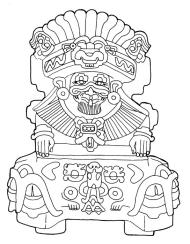
Glyphs:  A glyph C in the headdress. The throne is decorated with the glyph for corn grain.

Click to view high resolution in a new window
select this image for review

Key:  MCSJM 2
Actual Location:  Community Museum, San José Mogote, Oaxaca, Mexico.
Provenance:  San José Mogote, Oaxaca.
Chronology:  Peche 500 - 600 AD
  Click to view Chronology
Comments:  Effigy of a woman sitting on her haunches.
Glyphs:  Two numerals and glyph J (corn) in the headdress (2 J).

Click to view high resolution in a new window
select this image for review

Go to Page:  1 2 3 4 5 6 7 8