FAMSI Resources


Logo
570 records searched.


Results 11 - 25 of 106 for "maize or corn"
Key:  BM 1946/AM 19/6
Actual Location:  British Museum, London, England.
Collection:  Vice-Earl of Cowdray
Registration:  No. 1946/AM 19/6
Provenance:  Cuicatlán, Oaxaca
Measurements:  24 cm.
Color:  Grey clay with shades of yellow.
Reference:  Boos 1968: 3.
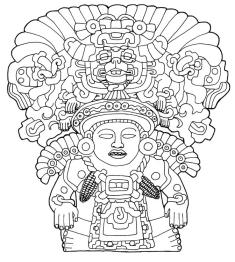
Comments:  This piece is almost like one that is at the Ethnographic Museum in Berlin, Germany (EMB 28354). The ear of corn is a representation of the virile member pierced by a cord in an act of ritual bleeding (cf. Sellen 2002: 14). Also see MFVW 274 for another human figure holding a blood letting cord in his hand.
Glyphs:  Glyph C in the headdress.

Click to view high resolution in a new window
select this image for review

Key:  MFVV 55.158
Actual Location:  Museum für Völkerkunde, Vienna, Austria.
Collection:  Edward Seler
Registration:  55.158
Provenance:  Santa María Atzompa, Oaxaca.
Measurements:  102.5 x 95 cm. (!) ; Boos da otras medidas 41 x 38 cm.
Color:  Traces of red paint. The face is painted in blue.
Chronology:  MA IIIB (Winter 1994a: 150); Pitao 350 - 500 AD
  Click to view Chronology
Reference:  Seler 1960: plate 17; Bernal 1966: 81, fig. 1; Boos 1966b: 73, fig. 52; Winter 1994a: 150.
Comments:  For other examples, see MNA 6-635, cm.A 44.78, EMB 24882, MDO 32 and MFR s/n 1. For an analysis of this type, see Sellen 2002: 9.
Glyphs:  Glyph C in the headdress. Cocijo mask (glyph M) flanked by two ears of corn.

Click to view high resolution in a new window
select this image for review

Key:  EMB 38471
Actual Location:  Ethnographic Museum (Ethnologisches Museum), Berlin, Germany.
Collection:  Walter Lehmann (donated to the EMB in 1909).
Registration:  IV Ca. 38471
Provenance:  Unknown
Measurements:  10.5 x 10.5 cm.
Color:  Grey clay
Chronology:  Late MA IIIB-IV (Winter 1994: 159); Xoo 600 - 800 AD
  Click to view Chronology
Reference:  Schuler-Schömig 1970: 116, plate 79; Winter 1994a: 159.
Comments:  A bat's head combined with a bat's claw.
Glyphs:  Epsilon or "blood" glyph in the corners of the mouth. It has two coefficient-5 bars in the eyebrows (10 epsilon?).
Dating:  TL by Goedicke et al. 1992: 70, test # 79: authentic (undated).

Click to view high resolution in a new window
select this image for review

Key:  MDO 33
Actual Location:  Dolores Olmedo Museum, Mexico City, Mexico (exhibited).
Collection:  Fernando Sologuren; Armilia Van Rijn (195?-1964); Dolores Olmedo Patiño (presently).
Registration:  Record from the National Anthropology and History Institute (INAH), P.F. 100, LO 33
Provenance:  Etla, Oaxaca, according to an undated foto by Rickards.
Measurements:  63 x 48.5 cm.
Color:  Dark grey clay
Chronology:  MA IIIA (Boos 1966b: 390); Pitao 350 - 500 AD
  Click to view Chronology
Reference:  Photo from Rickards, circa 1911 (document by Jorge Rickards); Caso and Bernal 1952: 209, fig. 346; Boos 1966b: 390, fig. 360a and b; Anton and Dockstader 1969: 45.
Comments:  This piece was probably found by Fernando Sologuren at the beginning of the last century. In 1928, Caso and Bernal (1952: 97) took pictures of the piece when it was at Mercedes Sologuren's house. At the beginning of the 1950s, the piece went to Machilda Armilia Van Rijn and then, in 1964, it was acquired by Dolores Olmedo Patiño (personal communication with Patricia Van Rijn, 1999). For a similar Etla style of this period compare it with MDO 32 and MFR 12619.
Glyphs:  Glyph E "Xoo" reproduced several times in the headdress. The headdress mask corresponds to glyph U. Above the mask's nose, a jaguar's head can be seen and, above it, the glyph for corn.

Click to view high resolution in a new window
select this image for review

Key:  MDO 32
Actual Location:  Dolores Olmedo Museum, Mexico City, México (exhibited).
Collection:  Fernando Sologuren; Armilia Van Rijn (195?-1964); Dolores Olmedo Patiño (presently).
Registration:  Record from the National Anthropology and History Institute (INAH) , P.F. 100, LO 32
Provenance:  Probably Etla, Oaxaca
Measurements:  51 x 46 cm.
Color:  Dark grey clay
Chronology:  Pitao 350 - 500 AD
  Click to view Chronology
Reference:  Caso & Bernal 1952: 98, fig. 163; Boos 1966b: 65; 50-peso bill circa 1973; Eubanks 1999: 137-138, fig. 110; Sellen 2002: 9, fig. 5e y 11, fig. 8.
Comments:  This piece was probably found by Fernando Sologuren at the beginning of last century. In 1928, Caso and Bernal (1952: 97) took pictures of the piece when it was at Mercedes Sologuren's house. At the beginning of the 1950s, the piece went to Machida Armilia Van Rijn and then, in 1964, it was acquired by Dolores Olmedo Patiño (personal communication Patricia Van Rijn, 1999). For other types, see MNA 6-635, cm.A 44.78, MFVV 55.158, EMB 24882 and MFR s/n 1. For an analysis of this type, see Sellen 2002: 9. For the same Etla style, see MDO 33 and MFR 12619.
Glyphs:  Glyph C in the headdress flanked by two glyphs of small plants and then, two glyphs for corn. The figure in the headdress corresponds to the Cocijo (glyph M).

Click to view high resolution in a new window
select this image for review

Key:  AMNH 164/322763
Actual Location:  American Museum of Natural History, New York, United States.
Collection:  Marshall H. Saville
Registration:  164/322763
Provenance:  Cuilapan, Oaxaca.
Measurements:  68.5 cm.
Color:  Light grey clay
Chronology:  Peche 500 - 600 AD
  Click to view Chronology
Reference:  Saville 1904: 58; Boos 1968a: vol. III, 27, plate X.
Comments:  Discovered by Saville in 1902. He found it in front of a tomb in Cuilapan (Saville 1904: 59). The hands have been restored for the object's exhibition.
Glyphs:  Glyph C in the headdress. The pectoral shows the glyph for "open corn grain", combined with glyph E.

Click to view high resolution in a new window
select this image for review

Key:  CMA 44.78
Actual Location:  Cleveland Museum of Art, Ohio, United States.
Collection:  Donation from the Eastman Family.
Registration:  44.78
Provenance:  Unknown
Measurements:  37 x 26.5 cm.
Color:  Light brown clay.
Chronology:  MA IIIA (Boos 1966b: 74); Pitao 350 - 500 AD
  Click to view Chronology
Reference:  Boos 1966b: 74, fig. 53.
Comments:  The pectoral and part of the headdress are missing from this piece. For other examples, see MNA 6-635, EMB 24882, MFVV 55.158, MDO 32 and MFR s/n 1. For an analysis of this type, see Sellen 2002: 9.
Glyphs:  Glyph C in headdress flanked by two ears of corn. Cocijo mask in the headdress (glyph M).

Click to view high resolution in a new window
select this image for review

Key:  MA t/104
Actual Location:  Monte Albán, built in the facade of tomb 104.
Provenance:  Monte Albán, Oaxaca.
Measurements:  91 cm.
Color:  Grey clay
Chronology:  Peche 500 - 600 AD
  Click to view Chronology
Reference:  Caso 1938: 73 and 76, fig. 92; Caso and Bernal 1952: 51, fig. 72.
Comments:  The figure holds a bag of incense in one hand and the other hand is stretched out. This hand was mutilated by a tourist a few years back. In 1938, Caso identified this piece as Pitao Cozobi or God of Corn, but later, together with Bernal, they decide to classify it, in their work of 1952, as the "God with Cocijo Head in Headdress". The headdress mask belongs to the Xicani and is flanked by two jaguar heads.

Click to view high resolution in a new window
select this image for review

Key:  MES 23.8.240
Actual Location:  Swedish Ethnographic Museum, Stockholm, Sweden.
Collection:  August Edwin Paulson
Registration:  23.8.240
Provenance:  Unknown
Measurements:  30.5 cm.
Chronology:  Peche 500 - 600 AD
  Click to view Chronology
Reference:  Linné 1938: 138, plate 20.
Comments:  Ears of corn can be seen in the headdress. Compare with the piece at the Amparo Museum (MAM 631) and with the piece at the American Museum of Natural History (AMNH 30.3/2301A).

Click to view high resolution in a new window
select this image for review

Key:  MAM 631
Actual Location:  Amparo Museum, Puebla, Mexico.
Collection:  Josué Sáenz
Registration:  National Anthropology and History Institute (INAH) Reg. 58 P.F., piece 631
Provenance:  Unknown
Measurements:  124 x 50 x 30 dia. cm.
Color:  Grey clay with traces of white paint. Red pigment in the vessel held in hands.
Chronology:  Peche 500 - 600 AD
  Click to view Chronology
Reference:  Easby et al. 1970: fig. 161; Amparo Museum 1993: fig. 62.
Comments:  A row of ears of corn can be seen in the headdress. Compare with the piece at the American Museum of Natural History (AMNH 30.3/2301A) and the piece in the Paulson collection (MES 23.8.240).
Glyphs:  Glyph C in the vessel held in hands.

Click to view high resolution in a new window
select this image for review

Key:  MRT 1
Actual Location:  Mexican Museum of Prehispanic Art, Rufino Tamayo, Oaxaca, Mexico.
Collection:  Rufino Tamayo
Provenance:  Unknown
Measurements:  aprox. 30 cm.
Color:  Grey clay
Chronology:  Xoo 600 - 800 AD
  Click to view Chronology
Comments:  Representation of a bat.
Glyphs:  Two epsilon glyphs in the corners of the mouth. The eyebrows are shaped like bar numerals.

Click to view high resolution in a new window
select this image for review

Key:  MES 23.8.307
Actual Location:  Swedish Ethnographic Museum, Stockholm, Sweden.
Collection:  August Edwin Paulson
Registration:  23.8.307
Provenance:  Tuxtepec, Oaxaca.
Measurements:  37.9 x 31.9 cm.
Color:  Front part in red. Traces of green paint.
Chronology:  Peche 500 - 600 AD
  Click to view Chronology
Reference:  Linné 1938: 160, plate 31.
Comments:  The piece has been partially restored. According to Linné, it was wearing a Cocijo mask.
Glyphs:  Glyph J in the headdress. Two alligator eyes in the throne's back and above these, two glyphs for sprouted corn.

Click to view high resolution in a new window
select this image for review

Key:  SOTH 1989.204
Actual Location:  Unknown
Collection:  Sotheby Parke Bennet Auction, 20 November 1989.
Provenance:  Unknown
Measurements:  38.2 cm.
Chronology:  Pitao 350 - 500 AD
  Click to view Chronology
Reference:  Auction's catalog, Sotheby's 1989: fig. 204.
Comments:  The figure is holding an ear of corn in the hands.
Glyphs:  Glyph C in the headdress.

Click to view high resolution in a new window
select this image for review

Key:  ROM 1399
Actual Location:  Royal Ontario Museum, Toronto, Canada.
Collection:  Constantino Rickards
Registration:  HM 1399
Provenance:  Santo Domingo Galiesa, District of Ocotlán, Oaxaca.
Measurements:  43.2 cm.
Color:  Light grey clay with a light grey coating.
Chronology:  Xoo 600 - 800 AD
  Click to view Chronology
Reference:  Photo from the Rickards Collection circa 1917; Rickards 1938: 164, plate V (Rickards published a copy of this piece); Treasures of Pre-Columbian Art 1959: no. 547; Woeller 1960: plate 28; Boos 1968a: vol. III, plate XI; Sellen 1999: fig. 1, 2002a.
Comments:  This piece has been forged with copies. The copies are in various collections in Europe and most of them have been proven false thanks to the TL test (cf. Schuler-Schömig 1970: 8, plate II, for the piece in Berlin and Mongne 1987: 25-26, fig. 10, for an example of the four pieces in Paris). Rickards (1938: 164) reports that four vessels like this one came out of a tomb in Santo Domingo. If this information is true, then the location of the other three original pieces is unknown.
Glyphs:  Glyph C in the headdress. The glyph on one side of the head is unknown. The glyph for corn in the right hand. In the left hand, possibly another unknown plant, maybe it is the young corn (cf. Sellen 2002b).
Dating:  TL by Shaplin and Zimmerman, 1978, test #21: authentic; TL by Lazos, Ortiz, Ruvalcaba and Sellen 1999, test #110375: authentic.

Click to view high resolution in a new window
select this image for review

Key:  ROM 1435
Actual Location:  Royal Ontario Museum, Toronto, Canada.
Collection:  Constantino Rickards
Registration:  HM 1435
Provenance:  Cuilapan, Oaxaca.
Measurements:  42 cm.
Color:  Grey clay with a lighter layer of stucco.
Chronology:  Xoo 600 - 800 AD
  Click to view Chronology
Reference:  Rickards 1922; Boos 1964b: plate XIa & XIb; Urcid 1998: fig. 3; Sellen 2000b, 2002b.
Comments:  This engraved cylinder has an identical companion (cf. Rickards 1922 and photos of the collection before it reached Canada). The location of the other piece is unknown. The use of this piece is also unknown (cf. Urcid 1998 and Sellen 2002b). The figure of Cocijo has been reproduced twice in the cylinder, carrying objects in both hands, probably corn plants in different stages of development.
Glyphs:  Glyph C in the headdress.
Dating:  TL by Lazos, Ortiz, Ruvalcaba and Sellen, 1999, test #110385: authentic.

Click to view high resolution in a new window
select this image for review

Go to Page:  1 2 3 4 5 6 7 8